"Glow" sounds like marketing until you notice what it actually describes. Skin looks luminous when it is smooth enough to reflect light evenly, and it looks dull when dryness and rough texture scatter that light. That is the whole secret, and it is why the oldest beauty traditions in the world, from Ayurvedic oil rituals to European rose creams, are really conditioning traditions.
Quick answer: seven herbs with long traditions in glow-focused skin care are moringa, echinacea, rose, rosemary, chamomile, calendula, and holy basil. Infused whole into plant oils, they condition skin so it feels soft and reflects light evenly, which is what "glowing" has always meant.
Plants have carried this job for centuries. Below are seven herbs we know well, most of them growing right now in our Tallahassee garden, and what each one brings to a formula built for the face.
1. Moringa (Moringa oleifera)
If one of Google's own suggested questions is "Which leaf is best for glowing skin?", moringa is the strongest candidate for the answer. The moringa tree is nicknamed the miracle tree in the regions where it grows, and its small green leaves are among the most nutrient-dense in the plant world, studied for their vitamins A, C, and E and a long list of polyphenol antioxidants.
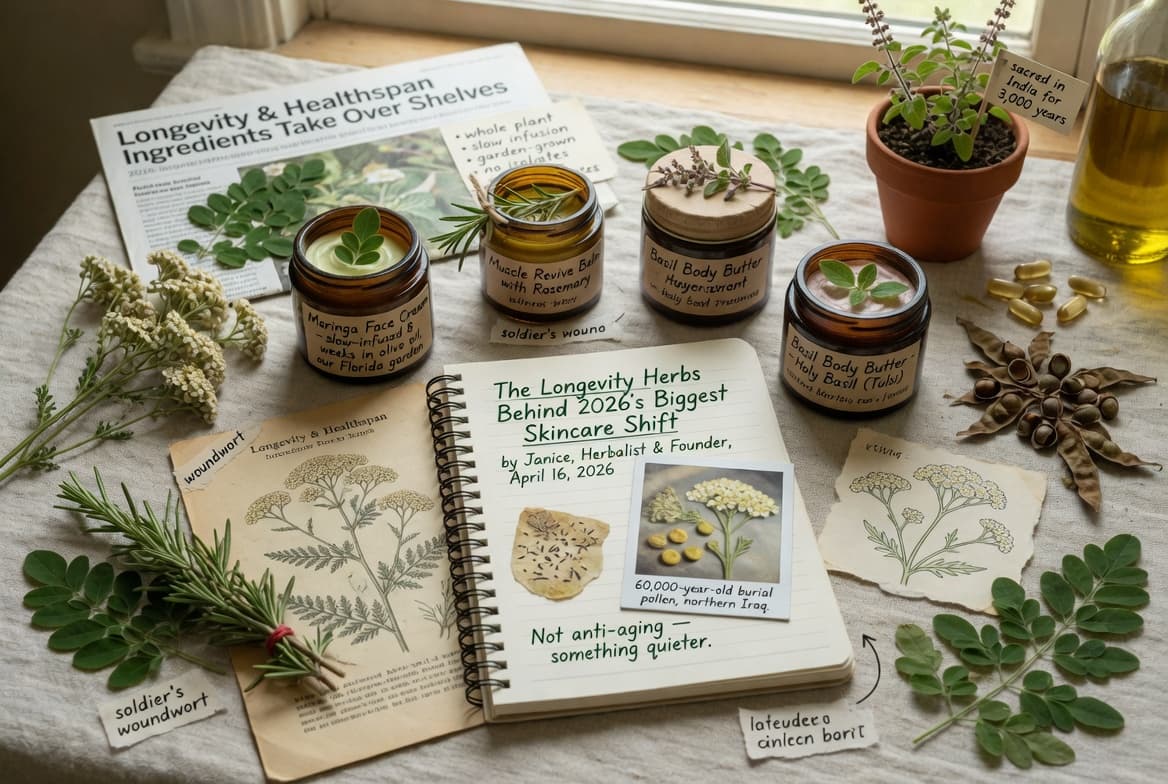
In skin care, that profile translates into a conditioning leaf with real substance behind it. We think highly enough of moringa to build a product around it twice over: our Moringa w/ Echinacea Face Cream carries whole garden-grown moringa leaves, slow-infused, alongside cold-pressed moringa seed oil. We wrote a full piece on what moringa actually does for skin if you want the deeper story.
2. Echinacea (Echinacea purpurea)
Most people know echinacea as the purple coneflower in wellness tea. Its skin story is quieter but genuinely interesting: researchers have studied Echinacea purpurea preparations in cosmetic formulations, with published work examining skin hydration and the appearance of fine lines. For a garden flower, that is an unusually direct paper trail into the cosmetics lab.
Echinacea is also simply a beautiful plant to grow, a tall prairie native that shrugs off Florida heat. Ours goes whole into the same face cream as the moringa, petals, and all the character the flower has to give. Its full profile is in our echinacea for skin guide.
3. Rose (Rosa hybrida)
No herb owns the glow tradition like rose. Persian rose water, European cold creams, Bulgarian rose valleys: for centuries, when people wanted skin that looked luminous, they reached for petals. Beyond the romance, rose brings a soft, velvety after-feel that you notice the moment a rose formula settles in.
We grow our own roses and infuse the petals whole into the Rose Renewal Crème, the most romantic bottle we make and the one our over-50 customers reorder most.
4. Rosemary (Rosmarinus officinalis)
Rosemary is the workhorse on this list. Its two signature compounds, carnosic acid and rosmarinic acid, are among the most studied antioxidants in the culinary-herb world, and in a natural formula they earn their keep twice: once conditioning the skin, and once helping protect the plant oils around them from going stale.
That is why rosemary appears in more of our formulas than any other single herb, including both face crèmes. A glow formula is only as good as the freshness of its oils, and rosemary is the herb that minds the shop.
5. Chamomile (Matricaria chamomilla)
Glow is not only about richness; it is also about calm. Chamomile flowers contain bisabolol, a compound the cosmetics industry values so highly for gentle skin conditioning that it is used as a standalone ingredient worldwide. Skin that feels comfortable simply looks better, and chamomile is one of the gentlest herbs in the entire tradition.
In our garden chamomile grows as a winter crop, one of the quiet pleasures of a Florida cool season. It is not in our current lineup, which makes it a perfect candidate for the DIY route below.
6. Calendula (Calendula officinalis)
The golden petals of calendula are the classic first herb of home skin care, rich in resins and flavonoids that transfer beautifully into oil. Herbalists have reached for it for centuries whenever skin looked rough or weathered, which is exactly the texture problem that steals a glow.
We grow calendula but do not currently bottle it, and honestly, it is one of the best herbs to try infusing yourself: easy to dry, easy to infuse, forgiving of beginner mistakes. Our free whole-herb infusion guide walks through the method step by step.
7. Holy Basil (Ocimum tenuiflorum)
Tulsi, as it is known across South Asia, has held a central place in Ayurvedic tradition for thousands of years, skin care very much included. Its leaves carry eugenol and other aromatic compounds with a long record in traditional beauty preparations, and it brings a warm, green depth to any oil it steeps in.
Holy basil goes into our Basil Body Butter along with sweet and Thai basils, for the days when the skin that needs a glow is shoulders and legs rather than cheeks.
How These Herbs Actually Get Into a Bottle
A jar of dried petals on a shelf will not make anyone luminous. The compounds above are locked inside the plant material, and the extraction method decides what actually reaches your skin.
Our method is whole-herb infusion: whole dried herbs steeped in plant oils for six to eight weeks in cool, dark conditions, long enough for both the delicate aromatics and the heavier fat-soluble compounds to migrate into the oil. For the face, that infused oil becomes a waterless crème: no water phase, so every drop is concentrated formula, with mango butter and prickly pear seed oil giving the texture its body. You can follow the whole process on our How It's Made page.
The Seven at a Glance
An Honest Word About Glow
No herb outworks the basics. Sleep, water, and sunscreen do more for how your skin looks than anything sold in a bottle, ours included. What a well-made herbal formula adds is the conditioning layer: skin that is soft, smooth, and comfortable reflects light the way "glowing" promises, and it does it every day, not just after a good night.
A few pointers for reading any glow product, ours or anyone's:
- Look for the plant, not the promise. A label that names the actual botanical (Moringa oleifera, Rosa hybrida) tells you the herb is in the formula. A label that names a benefit tells you what the marketing department hopes.
- For the face, concentration beats volume. Water-first creams feel light because most of the formula evaporates. A waterless crème works in pea-sized amounts and stays put; apply it to slightly damp skin and it locks that moisture in.
- Glow is a morning-and-evening habit, not an event. The conditioning that changes how skin reflects light comes from consistency, which is an argument for a formula you genuinely enjoy using.
Our own answer to all of the above is the Moringa w/ Echinacea Face Cream: garden moringa, echinacea, and rosemary infused whole into apricot kernel and grapeseed oils, with mango butter, prickly pear seed oil, and cold-pressed moringa seed oil, made for everyday use. If rose is more your ritual, the Rose Renewal Crème is the same waterless architecture built around our garden roses.
This article is for educational purposes. InVine Botanicals products are cosmetics, formulated to moisturize, soften, and condition the skin. They are not intended to diagnose, treat, cure, or prevent any disease.