Quick answer: Waterless skincare (sometimes called anhydrous skincare) is formulated entirely without water, built instead from plant oils, butters, and waxes. The practical benefits: every gram in the jar is formula rather than dilution, it needs far less preservation because microbes can't grow without water, it keeps longer, and a small amount goes a long way. The honest trade-offs: a richer texture and a higher upfront price. Here's how waterless formulas actually work, and how to get the most out of one.
Pick up almost any moisturizer in a drugstore and read the label. The first word is nearly always the same: water (or "aqua," which is the same thing in label Latin). Cosmetic ingredient lists are written in descending order, whatever appears first, there is more of it than anything else in the jar. When water leads the list, you're holding a product that is mostly water.
That's not a scandal. Water is safe, it's weightless on the skin, and it's what gives a lotion that light, disappearing feel. But it changes what you're actually buying, and over the past few years, a growing corner of the skincare world has been asking what happens when you take the water out. We reformulated our own crèmes around exactly that question, so this is a subject we've thought about at the level of the ingredient scale, not the trend piece.
Three companion reads: what a waterless creme does for mature skin, how it compares to Cetaphil's water-first formula, and how it measures up against the beef tallow trend, the other waterless philosophy.
What "Waterless" Actually Means
A conventional cream is an emulsion: a water phase and an oil phase, held together by emulsifiers the way a vinaigrette is held together by mustard. Because water is also the one thing every microbe needs to grow, a water-based formula has to carry a preservative system strong enough to keep the jar stable for a year or more of fingers dipping into it.
A waterless formula skips the water phase entirely. There is no emulsion to stabilize and no water for anything to grow in, just oils, butters, waxes, and the botanicals carried in them. The concept isn't new. Balms and salves have been anhydrous for as long as people have made them; the "waterless beauty" name arrived more recently, popularized by Korean formulators and picked up by brands thinking harder about water use. What's changed is that face and hand creams, categories long dominated by emulsions, are now being built this way too. To see the water-first strategy up close, our comparison of Neutrogena Norwegian Formula, a classic seven-ingredient emulsion, walks that label line by line.
The Benefits of Waterless Skincare
1. You're buying formula, not dilution
When water is the first ingredient, the actives, oils, and botanicals share whatever room is left. In a waterless formula, the ingredient doing the moisturizing is the bulk of the jar. That concentration changes how you use it: a pea-sized amount of a waterless crème covers what a generous scoop of lotion covers, and a small jar lasts months instead of weeks. The per-ounce price on the label and the per-use price in practice are very different numbers.
2. Far less need for preservatives
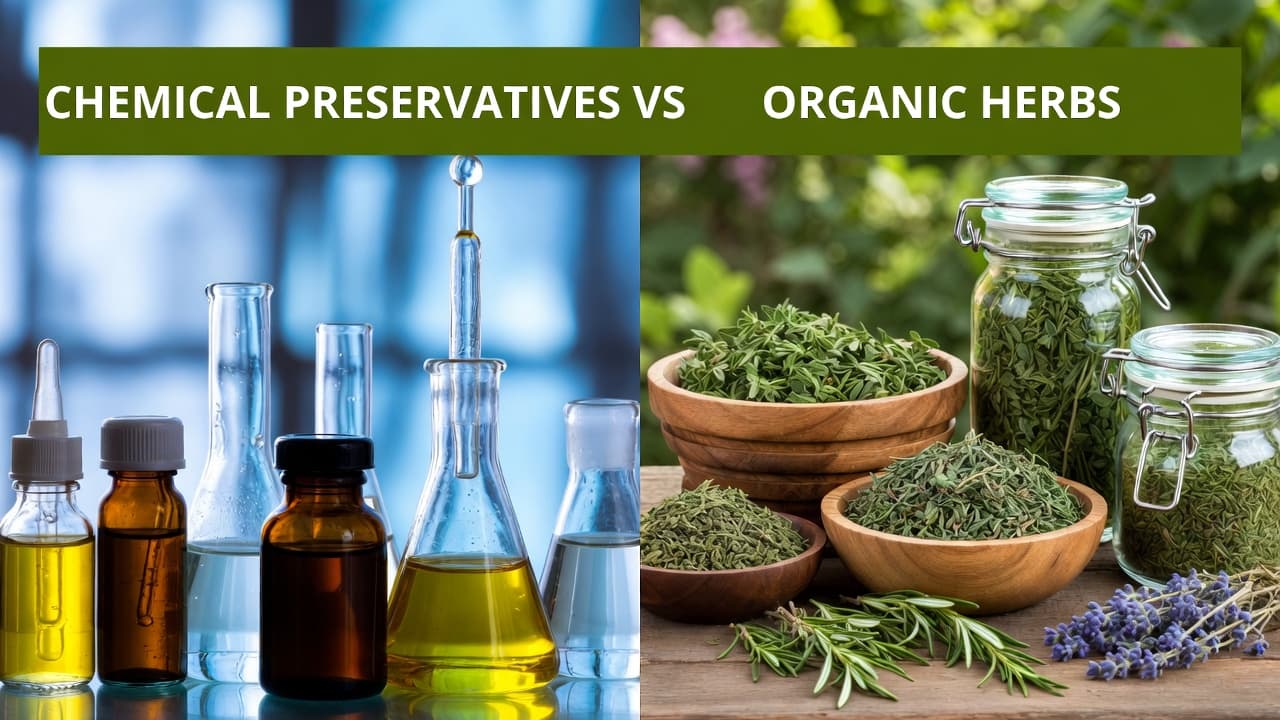
Preservatives exist in cosmetics for one main reason: water. Take the water out and a formula becomes a place microbes simply can't multiply, which means it doesn't need the robust preservative system an emulsion demands. (Shopping on exactly this promise? Our preservative-free face cream guide covers the two honest routes, including the sterile-packaging one.) That's why waterless products tend toward short ingredient lists, and it's one of the quieter benefits for anyone who prefers fewer synthetic ingredients on their skin.
3. A longer natural lifespan
Without water, the clock on a formula isn't spoilage, it's oxidation, the slow staling of plant oils exposed to air and light. That's a much slower and gentler clock, and it's the one natural antioxidants like Vitamin E are good at winding back. Stored with the lid on, away from heat and sunlight, a well-made waterless crème comfortably outlasts its water-based counterpart. (This is also why traditional salves were the way households kept botanicals through the seasons before refrigeration.)
4. A richer feel that stays where you put it
Water evaporates within a minute of application; the light feel of a lotion is partly the feel of most of it leaving. A waterless crème stays. The oils and butters form a soft, conditioning layer that keeps working, softening, smoothing, and holding moisture against the skin rather than vanishing. That staying power is why waterless formulas shine in exactly the places lotions give up: hard-working hands, elbows and heels, wind-chapped cheeks, and overnight use.
5. A lighter footprint
There's also the simple arithmetic of not shipping water around the country. A waterless jar delivers its uses in a fraction of the weight and packaging, nobody pays to truck the water that would have made up most of the formula. If sustainability figures into your skincare choices, this is one of the most direct levers there is.
The Honest Trade-Offs
Waterless isn't automatically better, it's a different set of choices, and it's fair to name what you give up.
The texture is richer. A waterless crème melts in rather than disappearing on contact. Most people come to love that, especially on hands and dry patches, but if you want a featherlight gel that's gone in five seconds, an anhydrous formula will feel like more product than you're used to. The fix is usually just using less.
The upfront price reads higher. Concentration costs more per jar even when it costs less per use. If you compare a waterless crème to a lotion ounce-for-ounce, the lotion wins; count the water out of the comparison and the math flips.
Waterless formulas don't add water to your skin. This is the most useful thing to understand about using them. An anhydrous crème excels at holding moisture, not depositing it, so it works best applied to skin that's slightly damp, right after washing your hands or your face. You're sealing water in, with botanicals along for the ride.
How We Make Our Waterless Crèmes
Every product in our current lineup is waterless. Our balms always have been, organic olive and coconut oils infused with whole herbs, blended with beeswax and Vitamin E. In 2026 we reformulated our three crèmes to take the last of the water out of the line. The newest is a waterless cleanser, which we explain in what to avoid in a cleansing balm.
The process starts in our Tallahassee garden. We grow the herbs ourselves, moringa, rose, spearmint, rosemary, dry them, and slow-infuse them whole for six to eight weeks in cool, dark conditions. For the crèmes, that infusion happens in organic apricot kernel and grapeseed oils, chosen for how lightly they sit on the skin. (Here's what whole-herb infusion involves, and why the carrier oil matters as much as the herb.)
From there, each formula gets its body from plants rather than a water phase. Velvety mango butter gives the crèmes their structure; the two face crèmes add prickly pear seed oil, a prized botanical oil, in place of any wax at all. Each jar is poured and capped by hand in small batches, from formulas I developed as InVine's founder and herbalist:
- Moringa w/ Echinacea Face Cream, moringa, echinacea, and rosemary infused in apricot kernel and grapeseed oils, with mango butter, prickly pear seed oil, and cold-pressed moringa seed oil, finished with lavender.
- Rose Renewal Crème, rose, rosemary, and spearmint, with mango butter, prickly pear seed oil, and a soft note of ylang ylang.
- Spearmint Hand Cream, garden spearmint with mango butter and beeswax, built for hands that are in and out of water all day.
You can see the full process, from harvest to jar, on how it's made, or explore the waterless crèmes.
Using a Waterless Crème Well
Three habits get you everything the format has to offer:
- Apply to damp skin. After washing, pat mostly dry and apply while a little moisture remains. The crème seals it in.
- Start smaller than feels right. Warm a pea-sized amount between your fingertips until it turns to oil, then press it in. Add more only where skin drinks it up.
- Store it like an oil, not a lotion. Lid on, out of direct sun, away from the hottest spot in the bathroom. Treated that way, the jar will outlast the season you bought it for.
Frequently Asked Questions
What are the downsides of waterless skincare?
Three honest ones: the texture is richer than a water-based lotion, the upfront price per jar is higher (though the per-use cost usually favors the concentrated formula), and anhydrous products hold moisture rather than adding it, so they perform best applied to slightly damp skin. None of these are flaws so much as differences; they reward a small change in habit.
Does waterless skincare have a longer shelf life?
Generally, yes. Water is what allows microbes to grow in a cosmetic, so removing it takes spoilage largely off the table and leaves oxidation, the slow staling of oils, as the main clock. Natural antioxidants like Vitamin E slow that further. Kept sealed, cool, and out of sunlight, waterless formulas typically stay fresh well beyond comparable water-based creams.
Is waterless skincare better than regular cream?
It depends on what you value. If you want maximum concentration, minimal preservatives, a longer-lasting jar, and a rich feel that stays put, waterless is the stronger format. If you want the lightest possible texture and an instant-absorb feel, a water-based lotion delivers that. Many people use both, a light lotion in the morning, a waterless crème for hands, dry patches, and overnight.
Water in a cream isn't a villain, it's a formulation choice, and an honest label lets you see which choice you're holding. Read the first three ingredients. If they're water, an emulsifier, and a silicone, you have a light emulsion that will feel lovely and leave quickly. If they're oils and butters you could trace to a grove or a garden, you have a concentrated formula that stays. We think the second kind earns its place in anyone's routine, which is why we make nothing else.
The information in this post is for educational purposes and reflects published ingredient listings and cosmetic chemistry. InVine products are cosmetics, not drugs.