Moringa keeps showing up on skincare shelves. "Miracle tree." "Superfood for your skin." "Ancient secret." The marketing language has gotten loud enough that it is worth stepping back and asking what is actually in the plant, how brands typically use it, and what changes when you put the whole leaf into a slow oil infusion instead.
The short version: moringa earns most of the attention it gets. The leaves carry an unusually dense compound profile that researchers keep returning to. But how a brand chooses to put moringa into a formula changes almost everything about what reaches your skin.
What Moringa Actually Is
Moringa oleifera is a fast-growing tropical tree native to the foothills of the Himalayas, now cultivated across India, Africa, Southeast Asia, the Caribbean, and the warmer parts of the United States. The leaves, seeds, bark, and seed-pressed oil have all been used in traditional skincare and culinary preparations across these regions for centuries.
The compounds that researchers focus on:
- Zeatin, a plant cytokinin (a growth-regulating compound) that is unusually concentrated in moringa leaves. It is fat-soluble, meaning it transfers into oil during slow infusion.
- Quercetin and kaempferol, flavonoids with a long history of study in plant chemistry. Both are present in the leaves at meaningful concentrations.
- Chlorogenic acid, a polyphenol also found in coffee beans and apples. Plentiful in fresh moringa leaves.
- Behenic and oleic acids, long-chain fatty acids that dominate the lipid profile of moringa seed oil. Oleic acid is the same compound that makes olive oil feel the way it does on skin.
- Carotenoids and vitamin A precursors, fat-soluble pigments that give the leaves their deep green color and contribute to the feel of moringa-infused oil.
That density is the reason moringa appears in nutrition science, agricultural research, and skincare formulations side by side. It is a single plant that carries a notably complete antioxidant profile.
How Most Moringa Skincare Is Actually Made
When a moringa product appears on a retail shelf, there is a high chance one of three things is happening behind the label:
- Dried leaf powder added to a manufactured base. Inexpensive to source, easy to claim, but the compounds in dried powder are not particularly bioavailable to skin without an extraction step.
- Seed-pressed moringa oil added at a low percentage to an existing emulsion or cream base. The oil is genuine, but at 1-2% inclusion most of what your skin actually contacts is the base formulation, typically water, emulsifiers, preservatives, and sometimes petroleum derivatives.
- Standardized moringa extract isolated for a single marker compound. The extract is concentrated for that one compound, and the rest of the plant's chemistry is left behind.
None of these approaches are wrong in themselves. Many of them produce perfectly nice products. But the marketing language ("powered by moringa," "ancient miracle plant") tends to imply a deeper engagement with the plant than the actual formulation delivers.
What Whole-Herb Infusion Does Differently
Whole-herb infusion is a slower, less concentrated approach with a different end product. The leaves are dried at low temperature and humidity to preserve the compound profile, then steeped in a carrier oil for six to eight weeks in cool, dark conditions. The carrier oil, in our case, organic olive oil, gradually pulls the fat-soluble compounds out of the dried leaf material.
The result is not a "moringa extract." It is an oil that has spent two months absorbing the lipid-soluble portion of the leaf's chemistry: the carotenoids, the flavonoids, the zeatin, the carrier-compatible fatty acids. The water-soluble compounds are left behind in the leaf material at strain time, which is what you want, those would not behave well in an oil-based formula anyway.
A few things change in that process:
- The fragile compounds are preserved. Heat and light degrade carotenoids and flavonoids quickly. A cold, dark, slow infusion is specifically designed to avoid that degradation.
- The compound profile is closer to whole-plant. Rather than amplifying a single marker compound, infusion captures the lipid-soluble fraction of the leaf's chemistry as a balanced complex.
- The carrier matters. Olive oil is itself a carrier with thousands of years of traditional use in herbal preparations. The carrier is not filler, it is the medium that determines how the plant compounds reach your skin.
From Our Garden
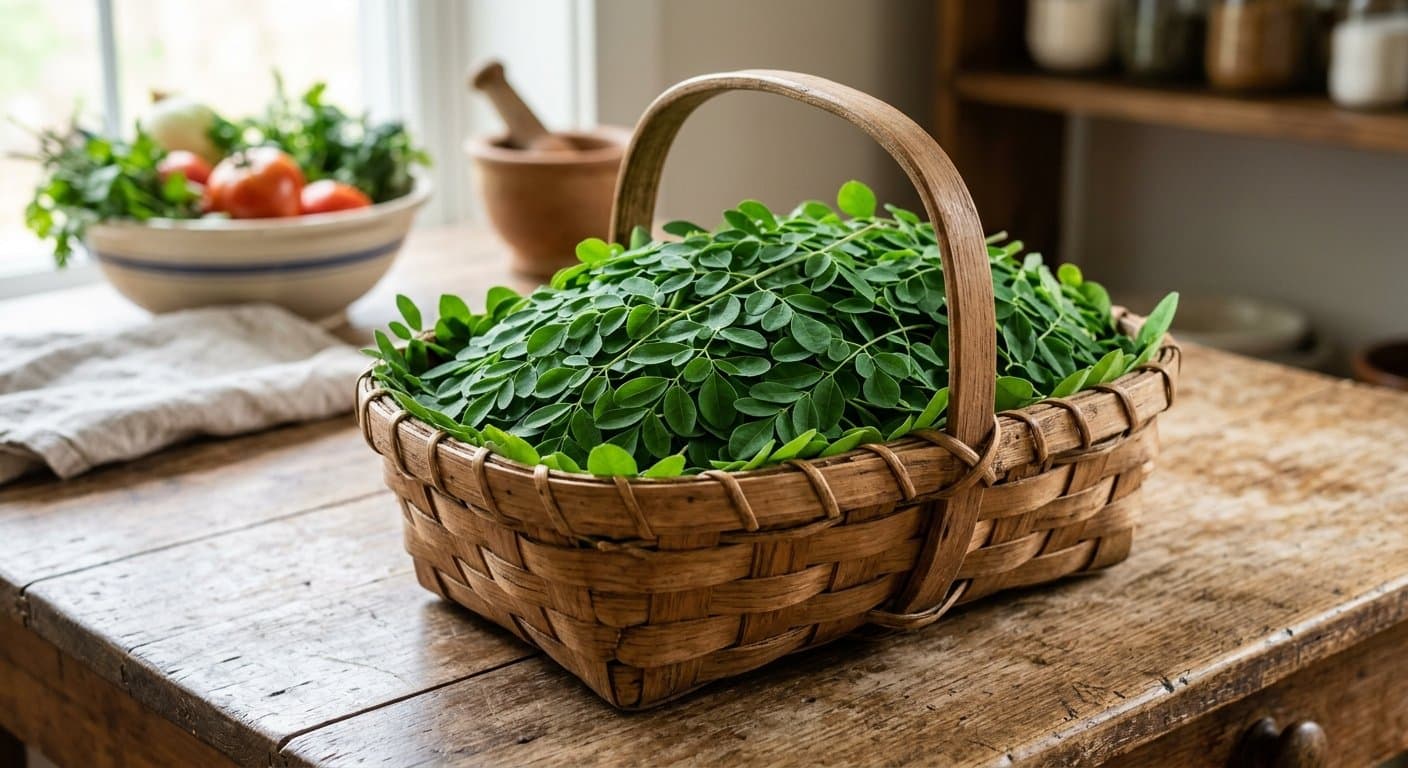
Moringa is one of the easiest plants we grow in our Tallahassee garden. North Florida sits at the northern edge of its happy range, but the warm, humid summers suit it well. A seedling planted in spring becomes a productive small tree by the end of its first season.
We harvest the young leaves at peak nutritional density, dry them in our climate-controlled drying room at 76°F and 35% humidity to preserve the compound profile, and slow-infuse them into organic olive oil for six to eight weeks depending on the herb used in the infusion. The infusion happens in cool, dark conditions, never solar-infused. Light degrades exactly the compounds you spent months trying to preserve.
After straining, the infused oil is blended with velvety mango butter, precious prickly pear seed oil, and organic cold-pressed moringa seed oil (the same plant, this time as its pressed seeds; we compared that seed oil head-to-head with rosehip), the formula is waterless, with no added water to dilute the botanicals, plus a small percentage of natural Vitamin E for shelf life. The result goes into our Moringa w/ Echinacea Face Cream.
Explore the Moringa w/ Echinacea Face Cream →
What to Look for, Whoever You Buy From
If you are exploring moringa skincare from any source, a few honest questions to ask:
- Where on the ingredient list does moringa appear? Ingredients are listed by weight. If moringa is near the bottom, it is a small fraction of the formula.
- Is it whole-leaf infused or extract-based? Both can be valid; they just do different things. Whole-herb infused oils tend to be greener in color and have a faint, grassy aroma.
- What is the base? A petroleum-based formulation will feel different on skin than a beeswax-and-plant-oil formulation, regardless of what botanical was added at the end.
- Where was the moringa grown? Most commercial moringa is imported. Garden-grown moringa is much less common, but it allows the brand to control harvest timing and drying conditions.
These are not gotcha questions; they are simply the questions that distinguish a moringa-marketed product from a moringa-built one.
Why We Made the Moringa w/ Echinacea Face Cream
Our Moringa w/ Echinacea Face Cream was built to use moringa the way the herbal tradition uses it, as a whole plant, slow-infused, in a base that does not work against the chemistry. The moringa is grown in our own Florida garden. The oil is a slow infusion, not an extract. The base is organic apricot kernel and grapeseed oils with prickly pear seed oil, cold-pressed moringa seed oil, and mango butter, a waterless formula, protected with Vitamin E.
It is a quiet product. It does not promise any single dramatic outcome. It is a moisturizing, conditioning cream built around one of the most compound-dense plants we grow.
That is what whole-herb infusion of moringa looks like in practice, not louder marketing, but a different relationship with the plant. And if you are weighing moringa against the rest of the garden, we ranked it among 7 herbs for glowing skin, and we explained why it shares a bottle with the coneflower in moringa and echinacea for skin.
The information in this post is for educational purposes and reflects traditional herbal knowledge and published research. InVine products are cosmetics, not drugs.