Quick answer: The closest natural alternative to Noxzema is an oil-based cleansing balm made from plant oils and beeswax, with no added water, no fragrance, and nothing that needs a preservative. InVine Botanicals' Moringa & Tulsi Herbal Cleansing Balm is one: garden moringa and tulsi infused whole in apricot kernel and grapeseed oils, with mango butter, kaolin clay, and beeswax. Noxzema Original Deep Cleansing Cream is a water-based cream built on stearic acid, with linseed and soybean oils and the camphor, menthol, and eucalyptus that give it its tingle. Below: what is actually in the blue jar, what it does well, and how a garden-grown balm compares.
If you grew up in an American house in the last hundred years, there is a good chance a cobalt blue jar sat somewhere near the bathroom sink. You may remember the smell before you remember the name. Noxzema is one of those products people do not so much choose as inherit, from a mother, a grandmother, an older sister with strong opinions about washing your face.
So nothing here is an argument against the blue jar. This post is for the person who still loves that end-of-day cleanse, started reading labels somewhere along the way, and wants to know whether the same habit exists in a version made from plants.
What's Actually in Noxzema
We read two published ingredient lists for Noxzema Original Deep Cleansing Cream: the manufacturer's SmartLabel page and a current national pharmacy listing. They agree on the heart of the formula and differ on the preservatives, which we will come back to.
The SmartLabel listing reads: water, stearic acid, linseed oil, soybean oil, eucalyptus leaf oil, fragrance, propylene glycol, gelatin, camphor, ammonium hydroxide, phenol, calcium hydroxide, menthol, sodium bicarbonate, calcium chloride, magnesium sulfate, potassium chloride. Seventeen ingredients, which sort into five jobs:
- The cream itself. Water is first and stearic acid is second. Stearic acid is a fatty acid found in plant and animal fats. Combine it with a small amount of an alkali (here, ammonium hydroxide and calcium hydroxide) and part of it turns into a soft soap that holds the water and oils together. This is the classic "vanishing cream" structure, and it is why Noxzema feels light and whipped instead of greasy.
- The plant oils. Linseed oil and soybean oil are third and fourth. The brand names both on the front of its own product page, along with eucalyptus. These are real plant oils, and they are part of what loosens makeup and the day's buildup.
- The tingle. Camphor, menthol, and eucalyptus leaf oil. This is the famous Noxzema feeling and most of the famous Noxzema smell, alongside the added fragrance.
- The helpers. Propylene glycol, a humectant that holds moisture; gelatin, a thickener; and a handful of mineral salts at the end of the list (sodium bicarbonate, calcium chloride, magnesium sulfate, potassium chloride).
- Preservation. Any cream with water in it has to be protected. The SmartLabel list, last updated in February 2021, includes phenol. The pharmacy listing shows phenoxyethanol, methylparaben, and propylparaben instead, plus disodium EDTA and the individual fragrance components (eugenol, linalool, limonene, geraniol, benzyl benzoate, cinnamal). Both lists cannot describe the same jar, so more than one version appears to be in circulation. The label on your own jar is the one to trust.
One more detail worth knowing: gelatin is animal-derived, so the classic cream is not a vegan product.
Credit Where It's Due
An honest comparison starts with what the jar gets right:
- It has real plant oils near the top of the list. Linseed and soybean oil are the third and fourth ingredients. Plenty of drugstore cleansers have no plant oil at all.
- It rinses clean. The brand's directions are simple: apply generously to a wet or dry face, massage with fingertips or a wet washcloth, and rinse thoroughly. No tissue, no residue.
- The price is a gift. It is one of the least expensive cleansers on the shelf, and the jar is a big one.
- The feeling is the point. That cool tingle is exactly what its fans want from a face wash, and nothing else on the shelf feels quite like it.
- It has lasted. A product does not stay on bathroom shelves for a century by accident.
The person looking for a natural alternative usually is not disputing any of that. They are asking a different question: can I keep the ritual and change what is in the jar?
Where the Blue Jar Came From
Noxzema has one of the better origin stories in the drugstore. The formula is credited to Dr. Francis J. Townsend, a physician who practiced near the Maryland beaches in the early 1900s and made it for vacationers who had spent too long in the sun. He passed the formula to a Baltimore druggist named George Bunting, who began selling it around 1917 as "Dr. Bunting's Sunburn Remedy." For the first few years Bunting and a colleague mixed, heated, and poured every jar themselves.
The name came later. As the story goes, a customer told Bunting the cream had "knocked" his eczema, and the remedy became Noxzema. It was sold in a small cobalt blue glass jar, advertised as "the miracle cream of Baltimore," and by 1937 was selling 15 million units a year. The brand has since passed through Noxell, Procter & Gamble, Alberto-Culver, and Unilever, and is marketed today by Evermark.
Somewhere along the way people discovered it made a very good face wash, and that is what it is sold as now: a cleansing cream, a cosmetic, in a blue plastic jar.
Why People Go Looking for an Alternative
Five reasons come up again and again:
- The tingle is not for everyone. Camphor, menthol, and eucalyptus oil are a strong combination. Some people love it. Others decide over time that they want a cleanser that feels like nothing at all.
- Fragrance. A collective term on a label, and one of the most common things people choose to skip. Our post on why fragrance on a skincare label is a red flag explains the reasoning.
- The preservatives. Phenol on one published list, phenoxyethanol and parabens on another. All legal, and all there because the cream is mostly water. A formula with no water does not need them at all, which we cover in waterless skincare.
- Eye makeup. Noxzema's directions say to avoid direct contact with the eyes, so many people end up using a second product for mascara and liner.
- They want the plants to be the product. Not two oils in a water cream. The oil itself.
Noxzema vs Pond's Cold Cream
These two jars sat side by side for decades and people still ask which is which. They are relatives, and they work differently.
| Noxzema Original Deep Cleansing Cream | Pond's Cold Cream Cleanser |
|---|
| First ingredient | Water | Mineral oil |
| What it is | A light, whipped, soap-style cream | A rich oil and water emulsion |
| Oils | Linseed and soybean (plant oils) | Mineral oil |
| Feel | Cool tingle from camphor, menthol, eucalyptus | Smooth and slippery, no tingle |
| How it comes off | Rinse thoroughly | Tissue or cloth, then rinse |
In short, Pond's is a true cold cream and Noxzema is closer to a vanishing cream that happens to be used the same way. We read the Pond's label in full in a natural alternative to Pond's Cold Cream.
A cleansing balm is the modern relative of both. It is oil-based like Pond's, it can be rinsed like Noxzema, and it has no water in it at all.
What a Whole-Herb Cleansing Balm Does Differently
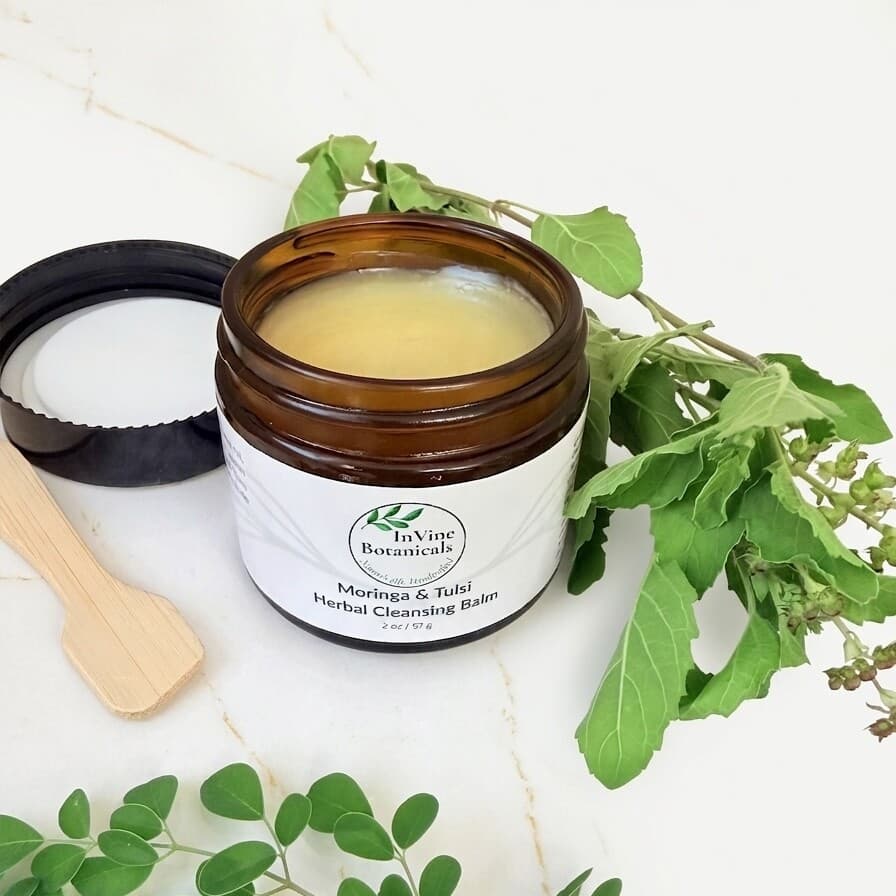
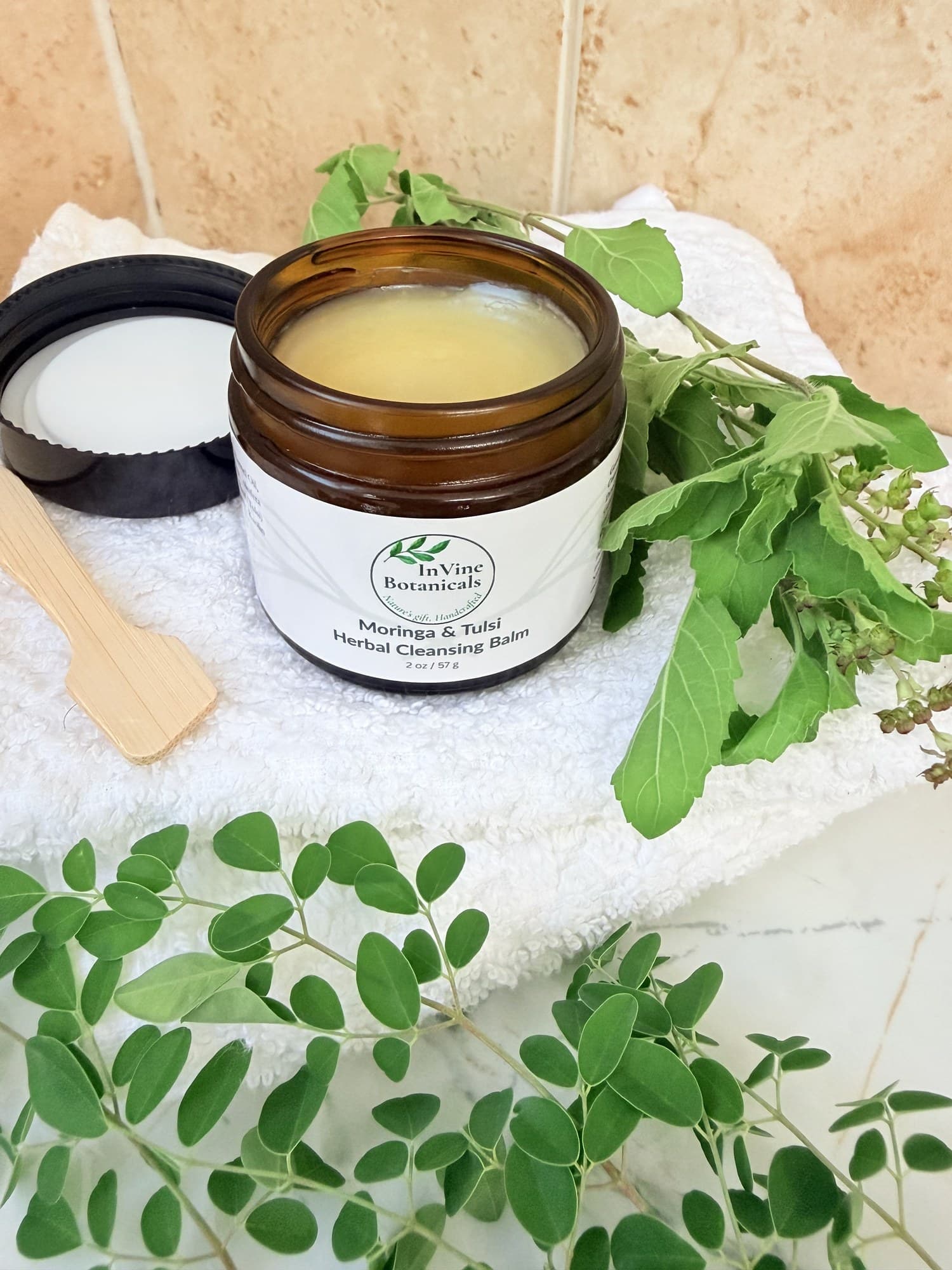
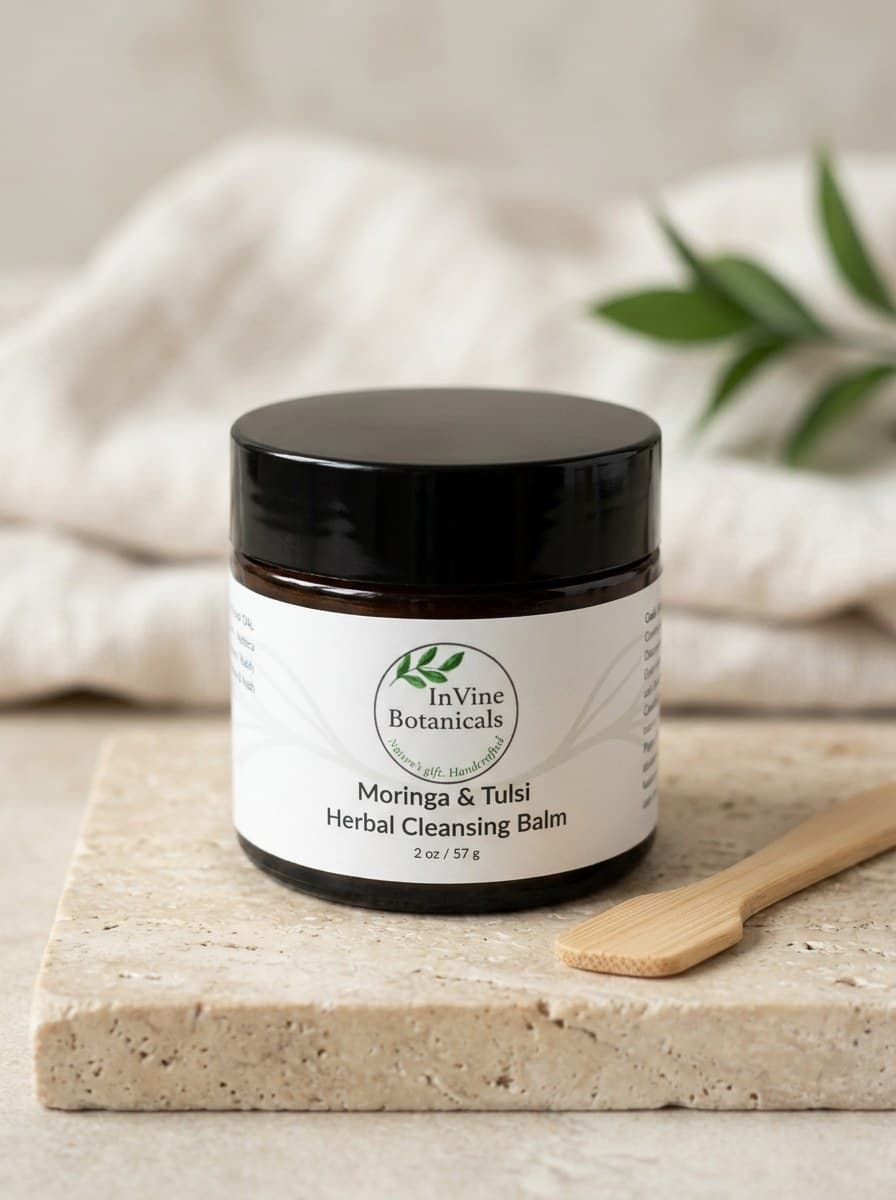
Our answer to the blue jar is the Moringa & Tulsi Herbal Cleansing Balm, which I formulated as the first step of the evening.
It starts in our Tallahassee garden. We grow the moringa and holy basil, also called tulsi, ourselves, dry them slowly, and infuse the whole herbs into apricot kernel and grapeseed oils for six to eight weeks in cool, dark conditions. That infused oil is blended with mango butter, a little fine kaolin clay, beeswax, and Vitamin E to help keep the oils fresh. Eight ingredients. No water, no added fragrance, and no menthol, camphor, or eucalyptus oil. Because there is no water in the jar, there is nothing for a preservative to do. The full process is on how it's made.
The routine will feel familiar. Scoop a small amount with the spatula and massage it onto a dry face, including around the eyes, where it softens into an oil that dissolves makeup and the day's buildup. Take it off with a warm, damp cloth or a rinse. Skin is left feeling clean, soft, and comfortable.
The structural comparison:
| Noxzema Original Deep Cleansing Cream | InVine Moringa & Tulsi Herbal Cleansing Balm |
|---|
| First ingredient | Water | Whole-herb infused apricot kernel oil |
| Type | Water-based cleansing cream | Waterless cleansing balm |
| Ingredient count | 17 on the manufacturer's list | 8 |
| Plant oils | Linseed, soybean | Apricot kernel, grapeseed, mango butter |
| Botanicals | Eucalyptus leaf oil | Garden moringa and tulsi, infused whole |
| Cooling ingredients | Camphor, menthol, eucalyptus | None |
| Preservatives | Yes; they vary by label version | None needed, the formula is waterless |
| Scent | Added fragrance | No added fragrance |
| Around the eyes | Directions say to avoid the eyes | Label directions include around the eyes |
| How it comes off | Rinse thoroughly | Warm, damp cloth or a rinse |
| Animal-derived ingredients | Gelatin | Beeswax |
| Price per ounce | Very low, a real strength | Higher; a small scoop does a full cleanse |
Neither column is dishonest. One is a century of affordable, reliable drugstore skincare with a feeling all its own. The other is plant oils, beeswax, and herbs from one garden, with nothing added that the formula does not need.
Grown in our garden, made by hand in small batches.
Meet the Moringa & Tulsi Herbal Cleansing Balm →
Other Honest Options
Ours is not the only way to do this, and it may not be the right one for you.
- A single plant oil and a washcloth. Olive, jojoba, or sweet almond oil massaged onto dry skin, followed by a warm, damp cloth, is the simplest natural cleanser there is. It is messier than a balm and it works. Our look at olive oil for skin covers what to buy.
- A cleansing oil. The same idea in a pump bottle. We compared the two formats in cleansing balm vs cleansing oil.
- A different cleansing balm. There are many, and they are not all built alike. Our guide to what to avoid in a cleansing balm shows how to read one in ten seconds.
- Make your own infused oil. If infusing herbs into oil appeals to you, our free whole-herb infusion guide walks through the method.
- Keep the blue jar. If the tingle is the reason you buy Noxzema, it is still the one that delivers it. Nothing natural we know of feels the same.
Choosing by Use Case
- You want the lowest cost per cleanse. Keep the Noxzema. Nothing natural competes on price, and we would rather say so.
- You love the tingle. Keep the Noxzema. That feeling comes from camphor, menthol, and eucalyptus, and our balm has none of them.
- You want plant oils without water, fragrance, or preservatives. A waterless cleansing balm is the direct swap.
- You wear eye makeup and want one product for all of it. An oil-based balm labeled for use around the eyes saves you a second step.
- You do not use animal-derived ingredients. Note that Noxzema contains gelatin and our balm contains beeswax. A single plant oil is your route.
- You wear very little makeup. A warm cloth and a few drops of plain oil may be all you need.
What matters is knowing what is in the jar and choosing it on purpose. The blue jar earned its century by the sink. If you are ready for the same quiet ritual in a jar of plant oils and garden herbs, that exists too.
The information in this post is for educational purposes and reflects published ingredient listings and cosmetic chemistry. InVine products are cosmetics, formulated to cleanse, soften, and condition the skin. They are not intended to diagnose, treat, cure, or prevent any disease.