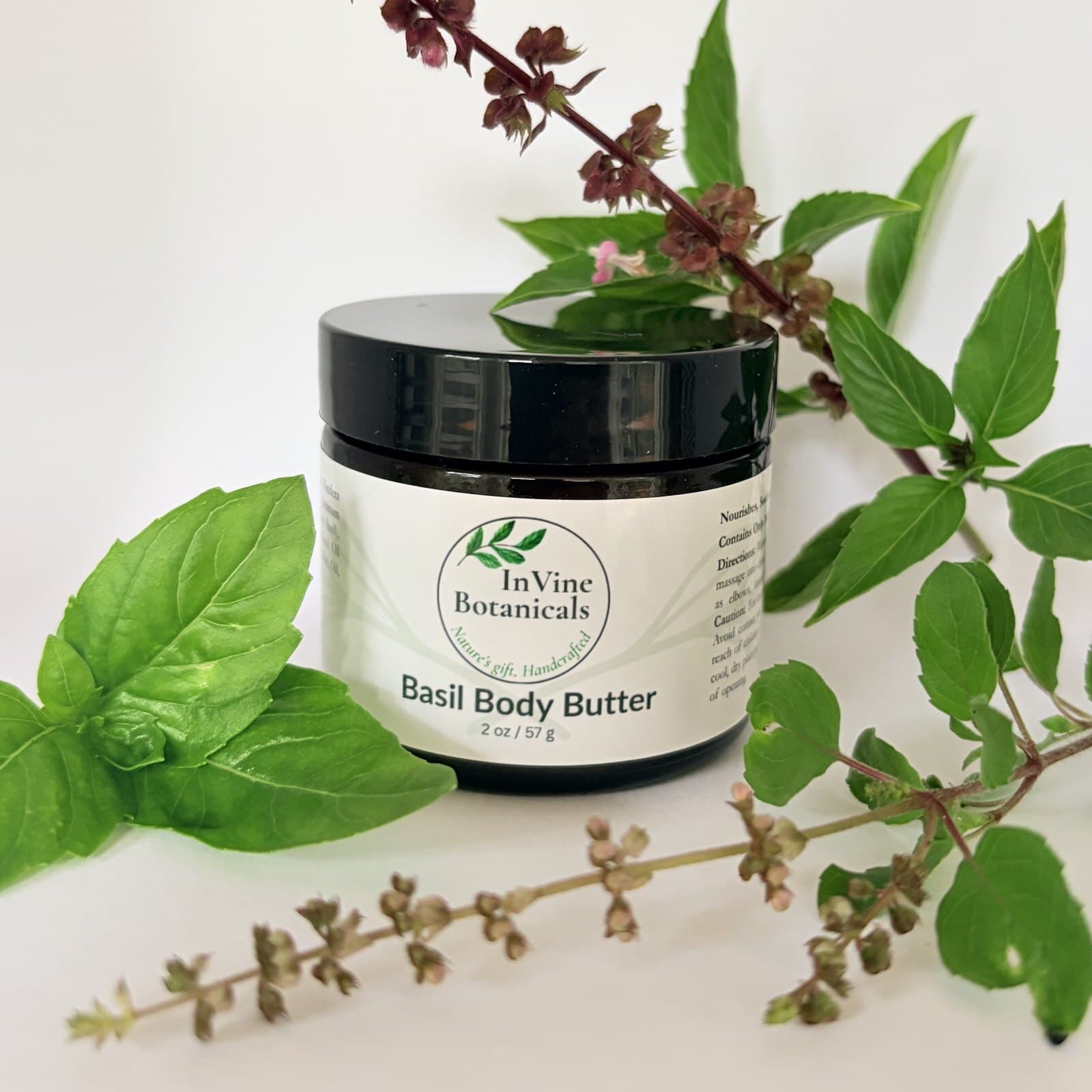
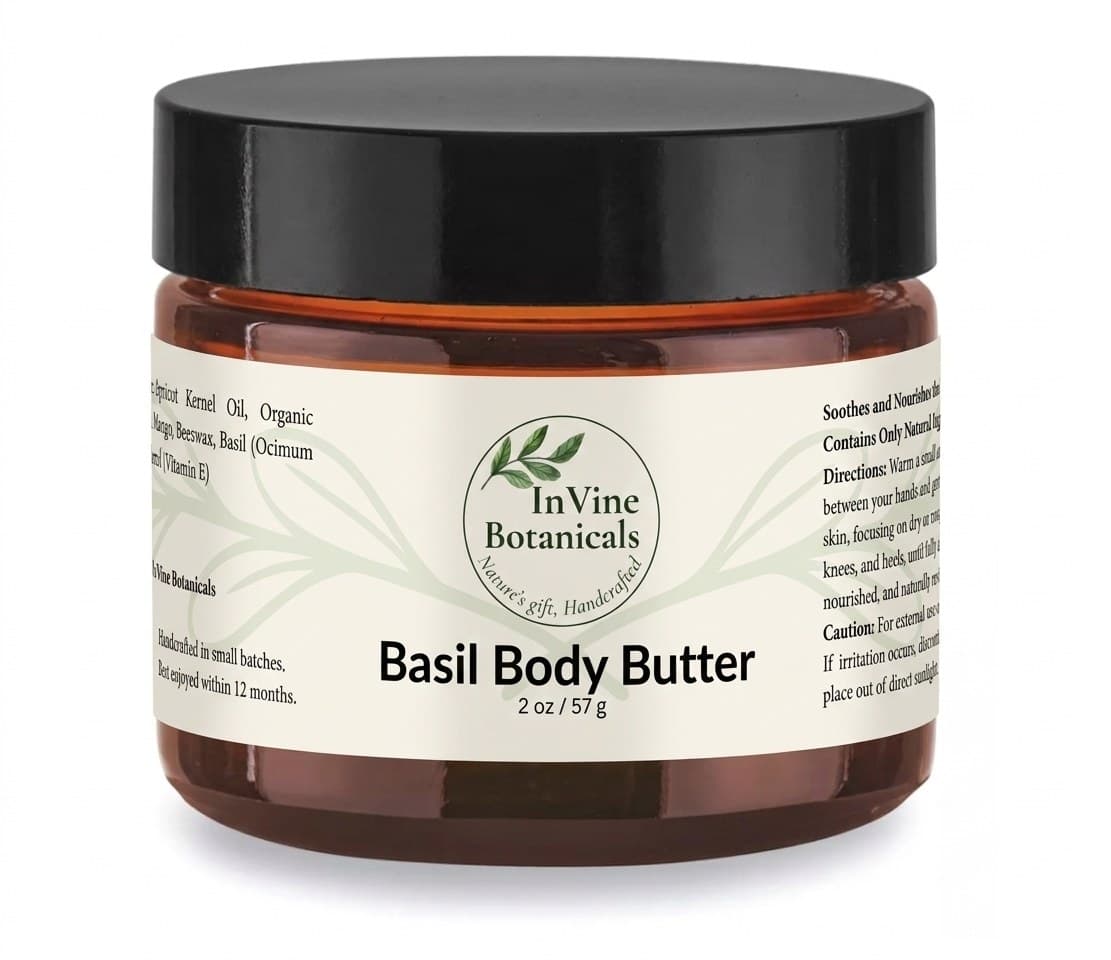
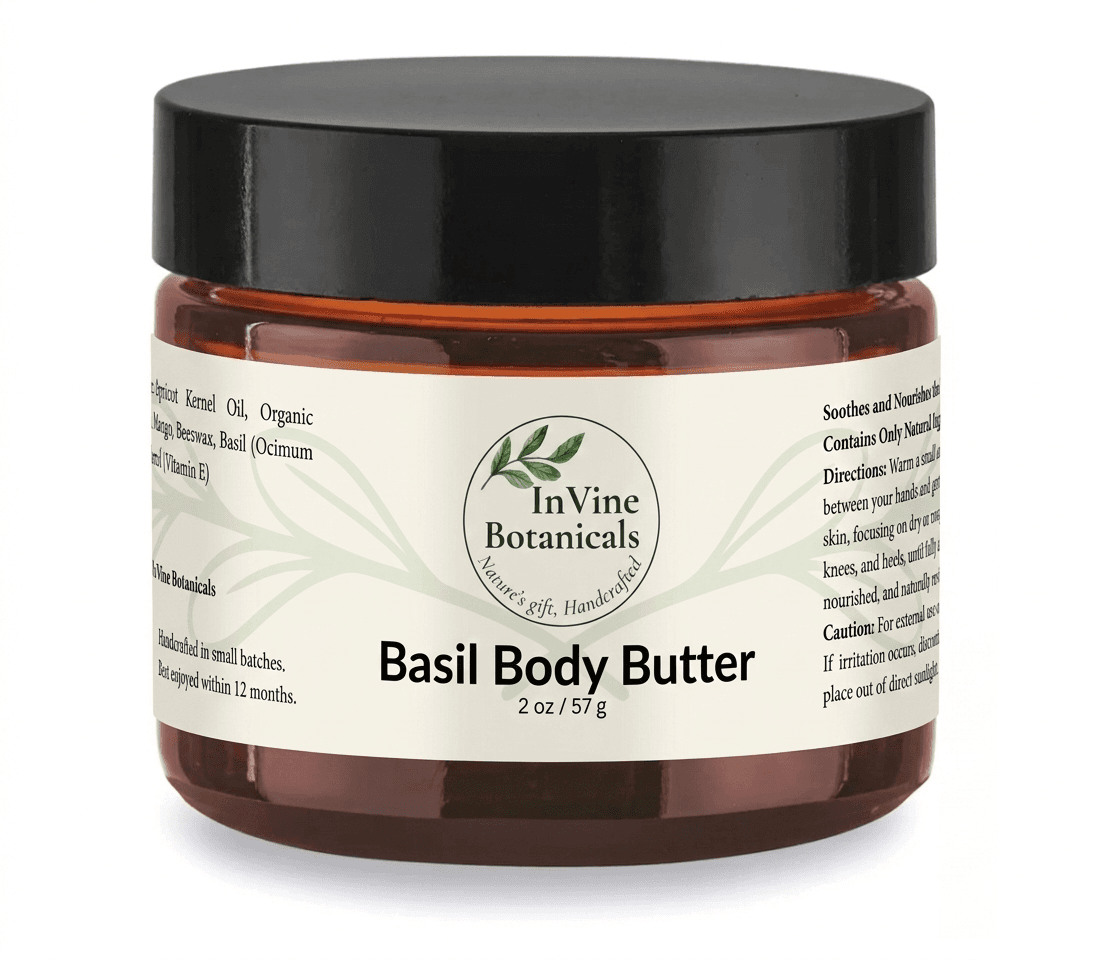
Quick answer: For everyday dry, rough skin, the closest natural alternative to Cicaplast Baume B5 is a waterless plant butter, where oils, butters, and beeswax do the softening instead of a water-and-silicone cream. Ours is InVine Botanicals' Basil Body Butter: three basils from our garden infused whole in apricot kernel and grapeseed oils, with mango butter, moringa seed oil, and beeswax. Eleven ingredients, no water, made for elbows, knees, heels, and anywhere skin runs rough. One honest limit up front: in the US, Cicaplast is a labeled skin protectant, and a cosmetic butter is not a substitute for that job. Below: what is in the tube, what it does well, and where a garden-grown butter fits.
Cicaplast Baume B5 is one of the most talked-about tubes in skincare. La Roche-Posay sells it in the US as Cicaplast Balm B5, though most people still use the French name, and searches for it have grown sharply over the past year. People keep it in a coat pocket for winter hands, on the nightstand for dry patches, and in the diaper bag.
If you love it, you do not need to be talked out of it. This post is for the person who turned the tube over, read the label, and wondered what a plant-based version of an all-purpose balm would look like.
Cicaplast Alternatives at a Glance
Start with what you use it for:
What's Actually in Cicaplast Baume B5
In the US, Cicaplast Balm B5 is sold as an over-the-counter skin protectant, so its label is filed with the FDA. We read both current listings on DailyMed (each published September 11, 2026), and they match.
- The active ingredient. Dimethicone 1%, a silicone, listed with the purpose "skin protectant." The label's stated uses include temporarily protecting chafed, chapped, or cracked skin, protecting from the drying effects of wind and cold weather, and diaper rash.
- The base. Water is the first inactive ingredient, followed by hydrogenated polyisobutene (a synthetic emollient), more dimethicone, and glycerin. This is a water-based cream, not an ointment.
- The plant ingredients. Shea butter is fifth on the list. Centella asiatica leaf extract is twelfth, and madecassoside, a compound from the same plant, is fifteenth.
- The B5. Panthenol, also called provitamin B5, is sixth. It is a well-known conditioning ingredient and it sits high on the list.
- The minerals and ferments. Zinc gluconate and manganese gluconate, plus a few ferment and prebiotic ingredients such as vitreoscilla ferment and alpha-glucan oligosaccharide.
- Preservation. Phenoxyethanol, with titanium dioxide closing the list. No fragrance appears on the label.
In all, that is one active and 34 inactive ingredients.
Credit Where It's Due
- It is a real skin protectant. That is a regulated category with a required label, and Cicaplast meets it. No cosmetic balm or butter, ours included, can make that claim.
- No fragrance on the list. For people who avoid scent entirely, that matters, and it is something our butter cannot offer, since ours is finished with lavender and peppermint essential oils.
- Shea butter and panthenol are high on the list, not sprinkled in at the end.
- It is a cream, not an ointment. That is a lighter format, and many people prefer it for daytime.
- The label is public. Anyone can read it on DailyMed, which is how we wrote this section.
Why People Go Looking for an Alternative
- Water and silicone first. If you are moving toward plant-based skincare, a base of water, a synthetic emollient, and dimethicone is the part you are moving away from.
- The length of the list. Thirty-five ingredients is ordinary for a water-based cream, but it is a lot to read on a tube you use every day.
- Everyday use, not a job for a skin protectant. Many people use Cicaplast simply as a rich moisturizer for dry spots. For that, a plant butter does the softening with far fewer ingredients.
None of this is a flaw in the product. It is a well-made cream doing a specific job. The question is whether that job is the one you are buying it for.
Is Cicaplast Similar to Aquaphor?
They are both sold as skin protectants, and people use them on the same dry spots, but they are built very differently. Aquaphor Healing Ointment is 41% petrolatum, a waterless ointment with seven ingredients in all. Cicaplast is a water-based cream with 1% dimethicone as its active, plus shea butter and panthenol. If you like the feel of Cicaplast but want something closer to an ointment, Aquaphor is the usual comparison. If you want neither petroleum nor silicone, a beeswax and plant-butter formula is the third path.
| Cicaplast Balm B5 | Aquaphor Healing Ointment | InVine Basil Body Butter |
|---|
| What it is | Water-based cream | Petrolatum ointment | Waterless plant butter |
| US label | Skin protectant (dimethicone 1%) | Skin protectant (petrolatum 41%) | Cosmetic |
| First ingredient | Water | Petrolatum | Basil-infused apricot kernel oil |
| Ingredient count | 35 | 7 | 11 |
| Plant ingredients | Shea butter, centella extract | None | Three garden basils, mango butter, moringa seed oil |
| Silicone or petroleum | Silicone | Petroleum | Neither |
| Preservative | Phenoxyethanol | None listed | None needed, the formula is waterless |
| Scent | No fragrance listed | No fragrance listed | Light lavender and peppermint essential oils |
| Best for | Chafed, chapped, cracked skin; diaper rash | Sealing in moisture | Softening dry, rough places on the body |
What a Whole-Herb Butter Does Differently
Our Basil Body Butter starts in our Tallahassee garden. We grow sweet basil, holy basil, and Thai basil, harvest them at peak, dry them slowly, and infuse the whole herbs into organic apricot kernel and grapeseed oils for six to eight weeks in cool, dark conditions. The infused oil is blended with mango butter, moringa seed oil, and beeswax, then finished with lavender and peppermint essential oils and a little Vitamin E. That is the whole label. The full process is on how it's made.
There is no water in it, so it needs no preservative. There is no silicone and no petroleum. The mango-butter body melts on contact and leaves skin soft and smooth, and the scent is light and fresh, never perfumey. A little goes a long way: one 2 oz jar typically lasts months of regular use.
It is made for elbows, knees, heels, and anywhere skin runs rough. Warm a small amount between your hands and massage it into clean, dry skin.
Grown in our garden, made by hand in small batches.
Meet the Basil Body Butter →
When Cicaplast Is the Right Tool
We would rather tell you this than have you find out:
- Chafed, chapped, or cracked skin. That is the labeled use of a skin protectant. Use the product made and labeled for it.
- Diaper rash. The Cicaplast label gives directions for it. Our butter is a cosmetic scented with essential oils and is not made for a baby's diaper area. Ask your pediatrician.
- You avoid all scent. Cicaplast lists no fragrance. Ours has a light essential-oil finish.
- You want a light cream, not a butter. A water-based cream is a lighter format than any butter, ours included.
- A doctor or dermatologist told you to use it. Keep using it.
And when a plant butter is the better fit:
- You use Cicaplast mostly as a moisturizer for dry elbows, knees, heels, and shins. This is exactly what a body butter is for.
- You want plants to be the formula. In our jar the basil-infused oil is the first ingredient, not the twelfth.
- You want a short label with no water, silicone, or preservative.
Plenty of households will keep both: the tube in the medicine cabinet for the days skin needs a protectant, and the jar by the bed for every other day. For more on choosing a butter, see our guide to herbal body butter, and for the ointment side of the shelf, a natural alternative to CeraVe Healing Ointment.
Reading an All-Purpose Balm Label in Ten Seconds
Three quick checks work on any tube or jar that calls itself a balm:
- Look for a Drug Facts box. If the package has one, the product is sold as an over-the-counter drug, usually a skin protectant, and the box names the active ingredient and exactly what it is for. Cicaplast and Aquaphor both have one. A cosmetic, like our butter, does not, and should not be asked to do a protectant's job.
- Read the first three ingredients. They are most of what you are buying. On Cicaplast they are water, a synthetic emollient, and a silicone. On Aquaphor, petrolatum and mineral oil lead. On a plant butter they should be oils and butters you recognize.
- Find the plants and count what stands ahead of them. Shea butter is fifth on the Cicaplast label and centella is twelfth. Neither position is wrong. It simply tells you whether the plants are the base of the formula or an addition to it.
How to Switch for Everyday Dry Spots
If you decide to try a butter for the everyday job, keep it simple. Use it after a shower on clean, dry skin, on the places that are always rough: elbows, knees, heels, shins. Start with less than you think you need, warm it between your hands first, and give it a few evenings before you judge it. Keep the Cicaplast tube where it is. The two are not rivals so much as different tools, and it is useful to know which one you are reaching for and why.
The information in this post is for educational purposes and reflects ingredient listings published on DailyMed as of the date noted. InVine products are cosmetics, formulated to moisturize, soften, and condition the skin. They are not intended to diagnose, treat, cure, or prevent any disease.