If you work a hospital floor, you already know the math. Hand hygiene before patient contact, after patient contact, after gloves, after charting, before meds, the studies say healthcare workers clean their hands dozens of times per shift, and the studies are underestimating your Tuesday.
By week's end the backs of your hands are tight and red. Your knuckles look ten years older than the rest of you. There's a crack starting at the corner of your thumbnail that stings every single time the sanitizer hits it, which is to say, constantly.
I'm an herbalist, not a nurse. But I formulated a hand cream for my own working hands, I grow herbs for a living, and garden hands and nursing hands turn out to be cousins, and over time, nurses became some of the people we hear from most. This is my honest guide to what's actually happening to your hands on shift, and what a hand cream has to do to keep up.
Why nursing is specifically hard on hands
Most dry-skin advice assumes your hands get washed a normal amount. Yours don't. Four things are stacking, shift after shift:
The wash count itself. Every wash with soap strips the thin film of natural oils your skin uses to hold moisture. Once or twice a day, skin rebuilds it easily. Twenty to forty times a shift, it never catches up. You're removing the barrier faster than your body can remake it.
Alcohol sanitizer is efficient, at everything. It's brilliant against what it's meant for, and it's also a solvent for skin lipids. The sting you feel on chapped knuckles is the solvent finding the places the barrier has already failed.
Gloves work against you twice. Inside the glove, hands sweat and the skin softens and over-hydrates; off comes the glove and that moisture flashes away, taking more with it. Donning gloves a dozen times a shift also means any cream you apply has to absorb completely, nothing greasy survives the first glove change.
Hot water and friction finish the job. Hot taps, paper towels, the general speed of the work. None of it is gentle, and none of it is optional.
The result is the classic healthcare hand: tight, rough, red across the knuckles, cracking at the corners, a skin barrier losing a war of attrition.
What a hand cream has to do to keep up with shift work
When I boil it down, a cream for wash-all-day hands has four jobs:
1. Replace oil, not just water. Most pump-bottle lotions are mostly water with a little oil, they feel nice for twenty minutes and evaporate. What stripped skin needs back is the oil phase: real plant oils and butters as a meaningful part of the formula. Ours is built on organic apricot kernel and grapeseed oils with mango butter, light-bodied, but genuinely lipid-rich.
2. Hold a barrier without leaving a film. Beeswax is the traditional answer and still the best one: a soft, semi-permeable layer that holds moisture in while your skin rebuilds. The formula has to absorb fully, though, you need to be able to glove up without sliding around inside the nitrile.
3. Bring calming botanicals that earn their place. Spearmint is cooling and gentle on skin that's had a punishing day; lavender grounds the formula; the waterless base keeps every drop concentrated. In our cream these come from whole herbs we grow in our Tallahassee garden, slow-infused in the oil for 6-8 weeks, working ingredients, not perfume notes.
4. Leave out the saboteurs. Synthetic fragrance and alcohol near the top of a label are exactly what already-stripped skin doesn't need. A short, readable ingredient list isn't an aesthetic preference in your line of work, it's risk management.
The honest scent paragraph
Many units run scent-conscious or outright scent-free policies, so let's be straight about it: our Spearmint Hand Cream smells like what it is, real spearmint and a touch of lavender. It's a soft, natural scent that fades as the cream absorbs, nothing like a synthetic perfume cloud. But if your floor is strictly scent-free, don't fight the policy: make this your end-of-shift and overnight cream rather than your med-cart cream.
That's no sacrifice, because overnight is where the real work happens anyway.
The routine that actually fits a shift
Before shift. A thin layer, fully worked in, before you leave the house. It gives your skin a head start on the first dozen washes.
On shift. Realistically: lukewarm water when you have the choice, moisturizer at actual breaks if your unit's policy allows a personal one, and pat, don't scrub, with the paper towels. Small things, compounding across forty washes.
After shift, on still-damp hands. This is the single biggest upgrade. A generous layer right after your end-of-shift wash, while hands are still damp, damp skin locks moisture in the way dry skin can't.
Overnight. The thick layer. Skin does its rebuilding while you sleep, and a soft beeswax barrier makes the difference between starting tomorrow's shift behind or ahead. If your hands are in genuinely rough shape, thin cotton gloves over the cream overnight is the old trick that still works.
About the cream I make
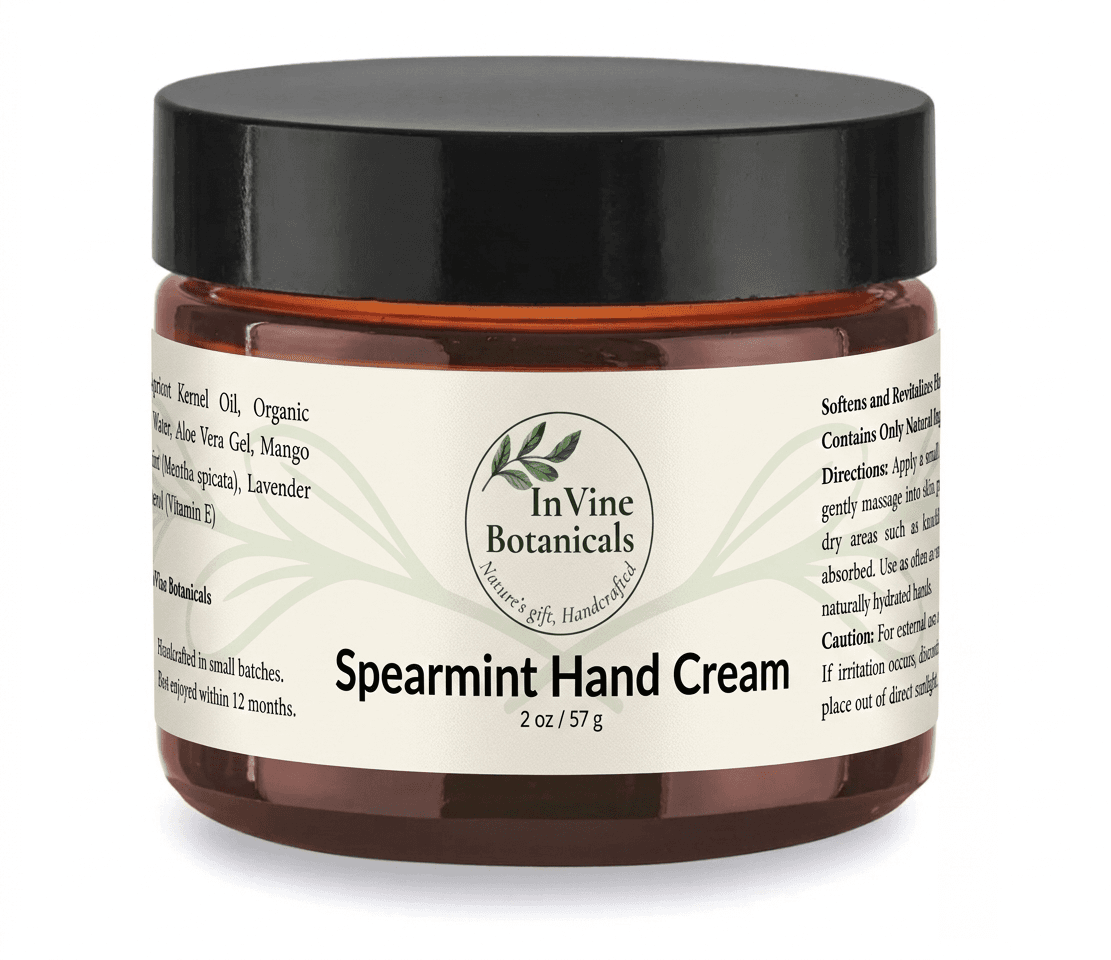
Our Spearmint Hand Cream is built on a slow infusion of spearmint grown in our own Tallahassee garden, whole leaves steeped 6-8 weeks in organic apricot kernel and grapeseed oils, blended with mango butter, beeswax from a local Tallahassee beekeeper, lavender essential oil, and Vitamin E. No synthetic fragrance, no parabens, no fillers. A 1 oz glass pump bottle, filled by hand in small batches, labeled with its batch number and infusion date.
It was formulated for hands that work and wash all day. Yours qualify several times over.
A last thought
Nobody clocks more hand-hygiene cycles than you do, and your hands shouldn't have to look and feel like they're paying for everyone else's safety. They're doing some of the most important work in the building. Twice a day, after shift and before bed, give them thirty seconds of the same care you spend your whole shift giving everyone else.
, Janice
Related reading from the InVine blog: