Every knitter knows the sound. That tiny zip of a rough fingertip catching on silk-blend yarn, or worse, the moment a hangnail you didn't know you had pulls a thread on the shawl you've been working on since October.
Crafters' hands have a problem most hand-cream advice never addresses: your hands aren't just dry, they're in contact with the work. Whatever is on your skin ends up in the fiber, and whatever roughness is on your skin ends up snagging it. You need hands smooth enough not to catch, and clean enough not to mark.
I'm an herbalist; my craft is herbs, and my hands take their own beating from soil and harvest shears. But the formula I built for my own working hands turned out to solve the crafter's version of the problem almost exactly, and knitters, quilters, and embroiderers have quietly become some of our most loyal customers. Here's the honest guide.
Why craft work is specifically hard on hands
Fiber wicks moisture off your skin. Wool, cotton, linen, natural fibers are absorbent by design. Hours of running yarn over the same finger does to that fingertip what a towel does to wet hands, very slowly. The yarn drinks first.
Friction builds rough spots exactly where you can't afford them. The tensioning finger, the thimble finger, the spot where the needle rests. Craft friction is gentle but extraordinarily repetitive, and it builds dry, papery patches precisely at the contact points.
Tiny injuries are constant. Needle pricks, rotary-cutter nicks, the dent a pair of embroidery scissors leaves after two hours. Each one is small; together they leave the skin around your fingertips perpetually a little compromised.
And then there's winter. Peak crafting season is dry-air season. The months you spend the most hours with yarn in hand are the months your skin has the least moisture to spare.
The cruel part: rough hands make the work harder, and the work makes hands rougher.
The crafter's special requirement: nothing greasy. Ever.
Here's where crafters part ways with every "intensive repair" hand product on the shelf: anything heavy, oily, or slow to absorb transfers straight into the fiber. A grease spot on hand-dyed merino or a quilt top doesn't come out easily, and you will not relax for a single row while worrying about it.
So the requirement is precise: a cream with enough real oil and butter to actually condition working skin, in a formula that absorbs completely, leaving fingertips smooth and dry to the touch, not coated.
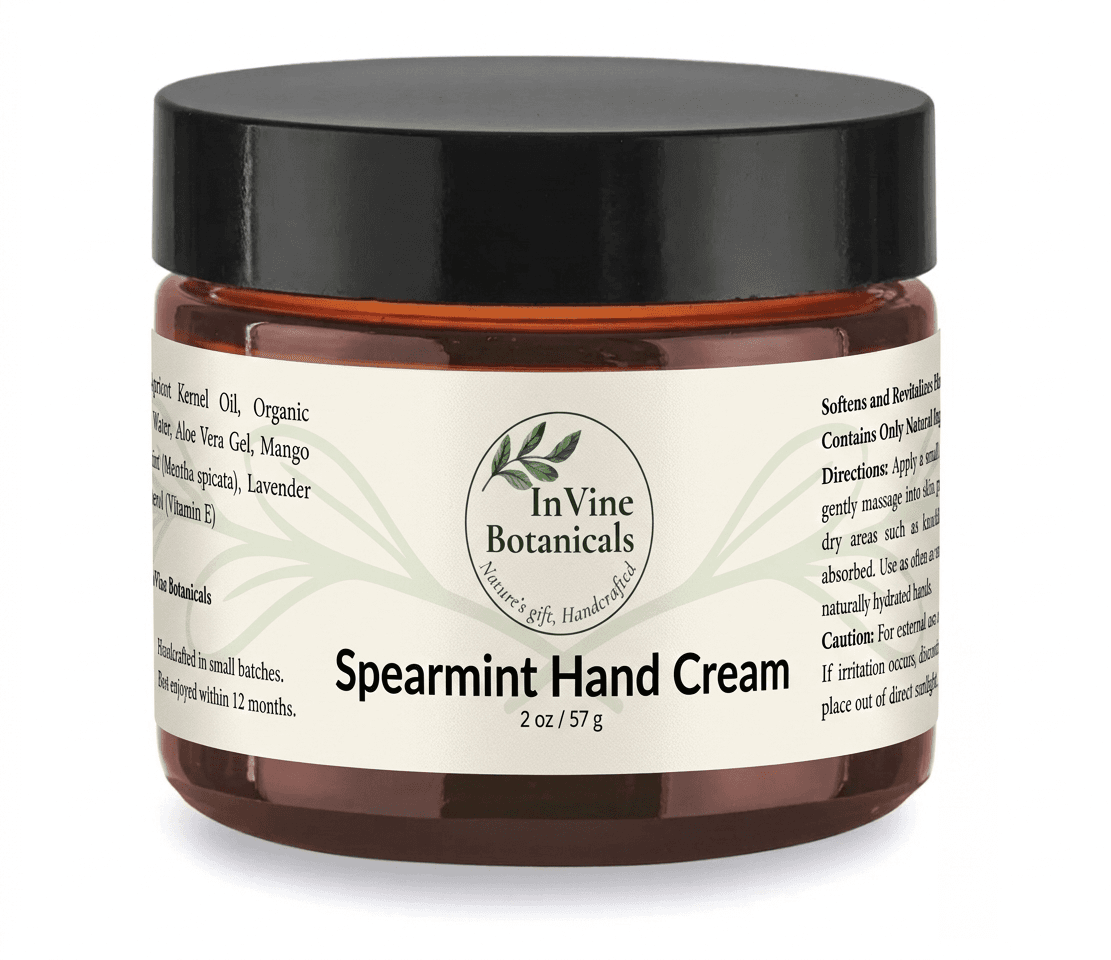
This is, honestly, why our Spearmint Hand Cream fits crafters so well, by lucky accident of formulation. It's built on organic apricot kernel and grapeseed oils, two of the lightest, fastest-absorbing carrier oils there are (the "dry oils," as formulators call them), with mango butter for moisture and just enough local beeswax to hold a soft barrier. It sinks in fully. Once it has, your hands feel smooth, not slick.
The timing rule that makes any cream work for crafting: apply at the end of a session, after washing up, and again before bed, not thirty seconds before you pick up the needles. Give it overnight to do its conditioning. By your next session your hands are smooth, fully absorbed, and safe for the good yarn.
What's actually in a cream that earns its place
The same four things I look for in any working-hands formula:
Real plant oils, not water with a little oil in it. Most pump lotions evaporate within the half hour. Skin that handles fiber for hours needs the oil phase replaced, apricot kernel, grapeseed, mango butter, as a real percentage of the jar.
A soft beeswax barrier. Beeswax holds moisture in while skin rebuilds, without the heaviness of petroleum bases. Ours comes from a Tallahassee beekeeper we've worked with for years.
Botanicals that work, from whole herbs. The spearmint in our cream is grown in our own Tallahassee garden and slow-infused whole into the oils for 6-8 weeks, cooling, gentle, a working ingredient rather than a fragrance. Lavender rounds it out, and the scent is soft and fades as it absorbs (your yarn will not smell like a candle shop).
A label you can read. No synthetic fragrance, no parabens, no fillers. Crafters are detail people; this is an ingredient list that survives detail people.
The routine, in craft terms
After each session: wash with lukewarm water and gentle soap, then a normal layer of cream on still-damp hands, worked in until fully absorbed.
Before bed: the generous layer. This is the one that does the real conditioning work, overnight, skin is most receptive, and there's no fiber around to protect.
Before a session with precious fiber: nothing new on your hands within the last half hour. Smooth hands from last night's cream, a quick file of any rough nail edge, and the silk is safe.
The emery board trick: keep one in your notions bag, not for your nails, for the papery spot on your tensioning finger that's about to start catching. Smooth it gently, cream it that evening.
About the cream I make
Our Spearmint Hand Cream comes in a 1 oz glass pump bottle, filled and capped by hand in small batches, labeled with its batch number and infusion date, traceable to the Tallahassee garden bed the spearmint grew in. It also makes a genuinely good gift for the crafter in your life, possibly paired with something from the gift sets if you're building a bigger bundle.
A last thought
Crafters extend more patience to their materials than almost anyone, blocking a shawl for days, pressing seams one at a time, untangling a skein instead of cutting it. Your hands are the one tool in the bag that gets none of that patience.
Thirty seconds of cream at the end of each session. That's the whole ask. The yarn will notice before you do.
, Janice
Related reading from the InVine blog: