Quick answer: The best hand cream for gardeners rebuilds the oils that soil and constant washing strip away, absorbs fast enough that you can pick up a trowel, and has a short label your hands can live with every day. Look for plant oils and butters near the top of the ingredient list, a wax or butter to hold moisture in, and botanicals you can actually find on the label. Use it before you go out, again on damp hands right after you wash up, and once more before bed. Below: why gardening is so hard on hands, what a gardener's hand cream has to do, and honest picks, including several that aren't mine.
If you garden with your hands in the dirt, actually in it, no gloves, fingers under soil, pulling weeds and thinning seedlings the way you've done it since you were eight years old, you already know what I'm about to describe.
The skin on your palms tightens. The pads of your fingers get a strange papery texture. A hairline crack opens on the side of your thumb and catches on every piece of fabric for the next week. Your knuckles redden. Your cuticles split. And no matter how much lotion you put on before bed, by lunchtime the next day your hands are sandpaper again.
This is not a hygiene problem, and it's not just the season. It's what a full day of real garden work does to skin.
I've been growing herbs in a Tallahassee garden for long enough to have tried a great many hand creams on my own hands, and eventually to have formulated my own. What follows is what I've learned: an honest guide for anyone who is tired of hand creams that don't keep up with a real day outside.
Why Gardening Is Specifically Hard on Hands
Most "dry hands" advice treats dry skin as one thing. Gardener's hands are their own category. Four things are happening at once, and they stack:
Soil is a desiccant. Dry soil is made of particles that bind water. When your skin touches it, moisture moves out of you and into the soil, the opposite of what your moisturizer is trying to do. The drier the soil, the stronger the effect.
Wet soil is hard on skin too. Long contact with water, including the water held in moist soil, softens and weakens the outer layer of skin, which is why people who wash dishes all day get the same kind of chapping gardeners do.
Tiny abrasions are everywhere. Woody stems, grit, thorns, sharp leaf edges. You don't notice them, but your skin does, and each one leaves it rougher and more easily irritated by plant saps like tomato leaf.
Then you wash your hands. A lot. Every wash, especially with harsh soap, strips the thin film of natural oils your skin was trying to rebuild. Most gardeners wash their hands many times a day in the growing season.
The result isn't just dry skin. It's a skin barrier that feels rough, cracks easily, and stings when it meets a lemon or a tomato. A good routine has to answer all four problems, not one.
What a Gardener's Hand Cream Actually Has to Do
When I was formulating my own, I boiled it down to four jobs:
1. Replace oil, not just water. Many drugstore hand lotions are mostly water with a small share of oil emulsified into them. They feel nice for a while, then the water evaporates. A cream that keeps up with gardening has to rebuild the oily film your hands lose every time you wash them, which means real plant oils and butters (apricot kernel, grapeseed, olive, shea, mango butter) as a meaningful part of the formula, not a line near the bottom.
2. Hold moisture in without a greasy glove. It should stay on the skin long enough to help, but absorb well enough that you can still pick up your tools. Beeswax is the traditional answer: a little of it helps hold moisture against the skin without a heavy, coated feel.
3. Bring skin-conditioning botanicals. Spearmint and peppermint feel cool and fresh. Calendula and chamomile are classic skin-soothing herbs. Rosemary is a natural antioxidant that also helps keep plant oils fresh. Lavender rounds out a formula and makes it something you enjoy putting on. Used properly, these are working ingredients, not perfume notes. (I go through seven of them in herbs for dry, hardworking hands.)
4. Keep the label short. When your hands are already rough, you'll use a cream more often if it's built from ingredients you recognize. A short list with no synthetic fragrance is easy to live with five times a day.
Whole-Herb Infusion vs. Essential Oil Scent
Many "natural" hand creams are built on a standard cream base (water, carrier oil, emulsifier, preservative) with a few drops of essential oil stirred in at the end for scent. That delivers fragrance, and very little of the plant itself.
A whole-herb infusion takes the opposite approach. Whole dried herbs are steeped in plant oil for 6-8 weeks depending on the herb used in the infusion. The oil slowly takes up the oil-soluble part of the plant: not just the aromatic compounds, but the resins, pigments, and other skin-conditioning constituents. In a hand cream, that infused oil becomes the base. The herbs are doing the work, not just scenting the bottle.
It's slower and it requires actually growing the herb, which is exactly why I do it. If you want to go deeper: whole-herb infusion vs. essential oil blends.
The Best Hand Creams for Gardeners: Honest Picks
Every gardener has a favorite, and several good options are not mine. Here is how the ones gardeners ask me about most actually differ. Ingredient details come from each product's published label; we've read each of them line by line in a dedicated post.
1. O'Keeffe's Working Hands
The concentrated, unscented jar that lives in a lot of potting sheds. It's water and glycerin based, sealed with paraffin and mineral oil, and dries fast with little residue. Good for anyone who wants an inexpensive, fragrance-free workhorse. Know that it lists no botanicals and uses a conventional preservative system. Our full read of the O'Keeffe's label.
2. Crabtree & Evelyn Gardeners Hand Therapy
The gardener's classic, with rosemary, sage, cucumber, and myrrh extracts and a famously matte finish that comes largely from corn starch, third on its list behind water and macadamia oil. The brand's site lists a Gardeners Hand Cream, shown as sold out when we checked in October 2026. Good for people who love a matte, dries-in-seconds finish. Know that the base is water with silicones and added parfum. What's in the green tube.
3. Neutrogena Norwegian Formula Hand Cream
A seven-ingredient, fragrance-free classic built on water and glycerin, still sold in its fragrance-free form. Good for a minimal, glycerin-rich option you can find anywhere. Know that it contains no plant oils or botanicals. The Norwegian Formula label, explained.
4. Bag Balm (for the worst nights)
Not a hand cream at all, but many gardeners keep the green tin for very rough hands overnight, under cotton gloves. It's petrolatum and lanolin with paraffin wax and a labeled antiseptic. Good for a heavy overnight layer. Know that it's a petroleum film that stays on the surface, so it's a bedtime product, not a daytime one. Bag Balm, honestly.
5. Spearmint Hand Cream (mine)
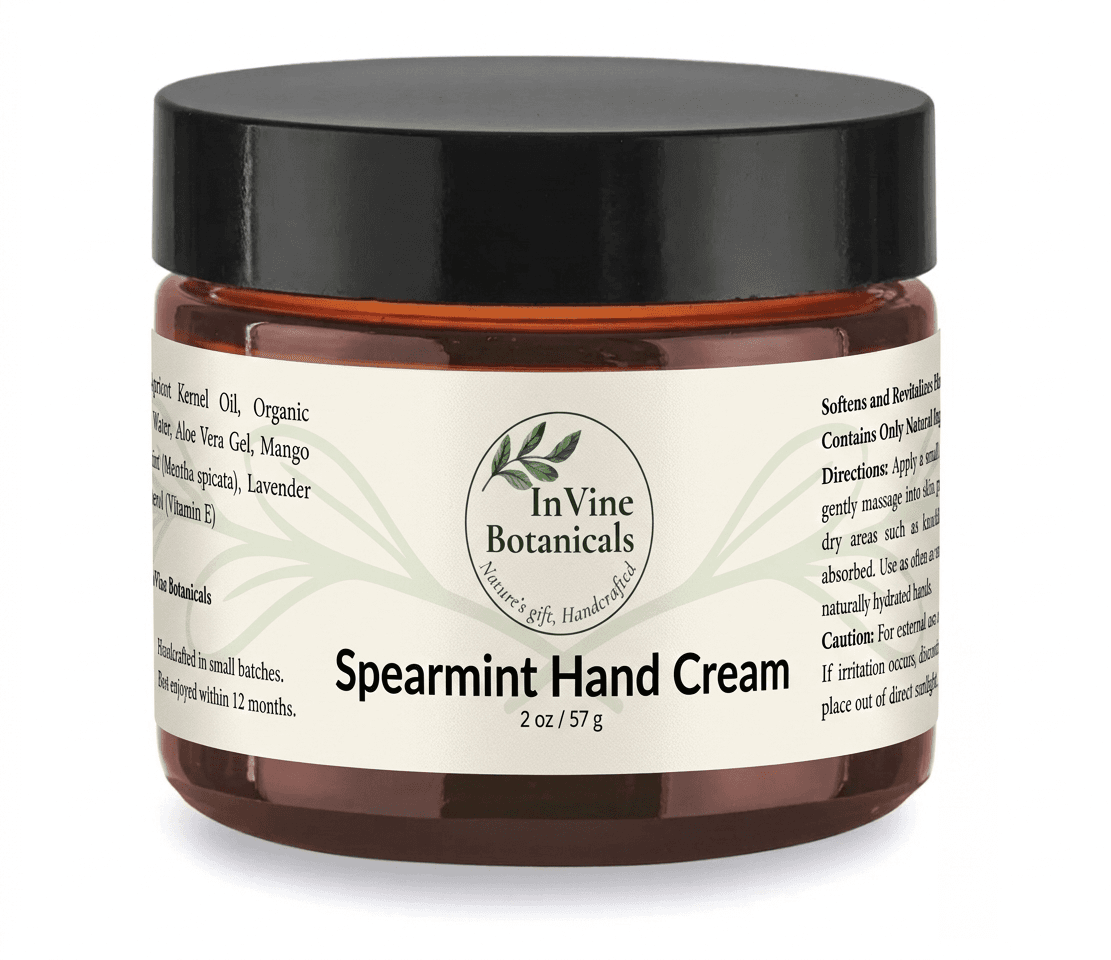
Our Spearmint Hand Cream is the one I wanted for myself. Spearmint grown in our Tallahassee garden is slow-infused whole in organic apricot kernel and grapeseed oils, then blended with mango butter, beeswax from a local Tallahassee beekeeper, a touch of lavender essential oil, and Vitamin E. It's waterless, so it needs no preservatives, and there's no synthetic fragrance: the scent is the spearmint itself. It feels light and absorbs readily, so it's on and gone before you reach for the trowel, and one 1 oz pump bottle typically lasts one to two months, depending on use. Good for anyone who wants the herbs at the top of the label in a cream you can use as often as you like.
At a glance
| Base | Botanicals | Scent | Finish |
|---|
| O'Keeffe's Working Hands | Water, glycerin, paraffin, mineral oil | None listed | Unscented | Fast-drying |
| Crabtree & Evelyn Gardeners | Water, macadamia oil, corn starch | Rosemary, sage, cucumber, myrrh extracts | Parfum | Matte |
| Neutrogena Norwegian Formula | Water, glycerin | None | Fragrance-free | Light |
| Bag Balm | Petrolatum, lanolin, paraffin | None | Faint | Heavy, overnight |
| InVine Spearmint Hand Cream | Spearmint-infused plant oils, mango butter, beeswax | Whole-herb spearmint, lavender | From the herbs | Light, absorbs readily |
The Hand Care Routine I Actually Use
I keep it simple. Five steps, no rituals.
Before gardening. A thin layer of hand cream, worked in for about thirty seconds before I go out. It doesn't replace gloves for rough work, but it gives your skin a head start and makes the dirt easier to wash off afterward.
While gardening. Gloves for anything involving thorns, brambles, roots, or sustained abrasion. Bare hands for anything delicate: transplanting seedlings, thinning lettuce, harvesting herbs. The test is whether the task needs finger feel. If it does, gloves lose every time.
The wash. Lukewarm water, not hot, and the gentlest soap I can get away with. Hot water and strong soap are harder on hands than anything I did with the plants. A soft nail brush by the sink takes care of the fingernails so I can stop scrubbing the skin itself.
After gardening, right away. A generous layer on still-damp hands. Damp skin is the best moment for any moisturizer, and a waterless cream holds that moisture in. This is the single biggest upgrade most gardeners can make to their routine.
Before bed. Another layer, with thin cotton gloves over it if my hands have had a rough week. By morning they feel like hands again.
That's the whole routine. It's less about any single product and more about catching your hands at the right moments.
A Gift for the Gardener in Your Life
Gardeners are famously hard to shop for because they already own every tool. A good hand cream is the gift that gets used daily. If you want to give more than one, the Garden Crème Gift Set pairs the Spearmint Hand Cream with our two waterless face crèmes, and our gifts for gardeners guide has plenty of ideas that aren't ours at all.
A Last Thought
A hand cream can't undo a hard gardening week on its own. What works is the combination: gloves when they belong, the right cream at the right moments, lukewarm water, and the small grace of treating your hands with some of the same care you already give your plants.
If you garden the way I do, half the time in gloves and half the time with the dirt right on your skin because that's the only way some of this work gets done, your hands are going to show it. That's part of the proof that you were outside. They just shouldn't feel like sandpaper.
Happy digging.
Janice
Related reading from the InVine blog:
The information in this post is for educational purposes and reflects published ingredient listings and cosmetic chemistry. InVine products are cosmetics, not drugs.