There's a particular kind of hand that comes out of a kitchen at the end of a long day. Washed twenty-five times. Scalded once or twice, lightly, in ways you stopped noticing years ago. Tight across the knuckles from dish soap, stinging faintly at the thumb crease where the lemon juice found a crack you didn't know was open yet.
Cooks' hands and gardeners' hands are close cousins, I know because I have the gardener's version. I grow culinary and botanical herbs for a living in Tallahassee, and the hand cream I eventually formulated for my own constantly-washed, constantly-working hands has quietly found its way into a lot of kitchens. This is my honest guide to why kitchen work wrecks hands, what actually helps, and, importantly, when to use a hand cream if you cook, because timing matters more for you than for anyone.
Why kitchen work is specifically hard on hands
The wash count. Raw chicken, then the cutting board, then an egg wash, then a handshake with the produce delivery, proper kitchen hygiene means washing your hands more times per day than almost any job outside healthcare. Every wash strips the thin film of natural oil your skin uses to hold moisture. At kitchen frequency, it never gets rebuilt.
Dish soap is a degreaser. Your skin barrier is grease. That's the whole problem in two sentences. The same surfactants that cut through a roasting pan make no distinction between rendered fat and the lipids holding your skin together.
Hot water, all day. Hot water strips oils dramatically faster than warm, and kitchens run hot by default.
Acids find every weak point. Citrus, tomato, vinegar, once the barrier is compromised, every acidic ingredient announces itself in the cracks. If lemon juice stings your hands, that's not sensitivity; that's a barrier asking for help.
Constant towel friction. The side towel is the cook's metronome, and a few hundred wipe-downs a day is its own kind of sandpaper.
The honest part: when NOT to wear hand cream in a kitchen
Let's deal with this up front, because it's the question that matters most for cooks.
You should not apply hand cream right before you cook. Any cream, including ours. You don't want lavender and spearmint anywhere near the aroma of a dish you're building, you don't want any film between your fingers and the dough, and you're about to wash it off within fifteen minutes anyway. Mid-service hand cream is wasted hand cream.
The cook's window is after the kitchen closes: the final wash-up of the night, and then again before bed. That's not a compromise, it's actually the optimal schedule. Skin does its real rebuilding overnight, and a cream applied to still-damp hands after the last wash, then again as a thicker layer at bedtime, catches both of the moments that matter. By morning prep, the scent is long gone, the cream is fully absorbed, and your hands start the day ahead instead of behind.
What a cook's hand cream actually has to do
Replace oil, not just water. Most pump-bottle lotions are water with a little oil emulsified in, gone by the next wash. Stripped skin needs the oil phase replaced with real plant oils and butters: our cream is built on organic apricot kernel and grapeseed oils with mango butter. Light-bodied, fast-absorbing, genuinely lipid-rich.
Hold a soft barrier overnight. Beeswax, ours comes from a local Tallahassee beekeeper, forms a semi-permeable layer that holds moisture in while the skin rebuilds. Traditional answer; still unbeaten.
Bring botanicals that earn their place. The spearmint in our cream is grown in our own garden and slow-infused whole into the oils for 6-8 weeks. It's cooling and gentle on hands that have spent twelve hours being scrubbed and scalded, a working ingredient, not a fragrance. A touch of lavender rounds out the finish.
Leave out what makes it worse. Synthetic fragrance and alcohol on top of barrier-stripped skin is throwing salt in the wound, sometimes literally, by feel. A short, readable ingredient list matters. Cooks read labels for a living; here's one that holds up.
The routine, in kitchen terms
Close of service: final wash with lukewarm, not hot, water, then a normal layer of cream on still-damp hands. Damp skin locks moisture in the way dry skin can't. This is the single highest-value habit on this page.
Before bed: the thick layer. If your hands are properly torn up, high season, double shifts, thin cotton gloves over the cream overnight is the old-school fix that still outperforms everything trendy.
Morning, before work: nothing, or the thinnest possible layer worked fully in before you leave the house. By the time you hit the kitchen, your hands should feel like skin, not product.
At work: the protection that's allowed in a kitchen is technique, lukewarm water when you can choose it, patting dry instead of scrubbing, gloves for the dishpit if that's part of your night.
About the cream I make
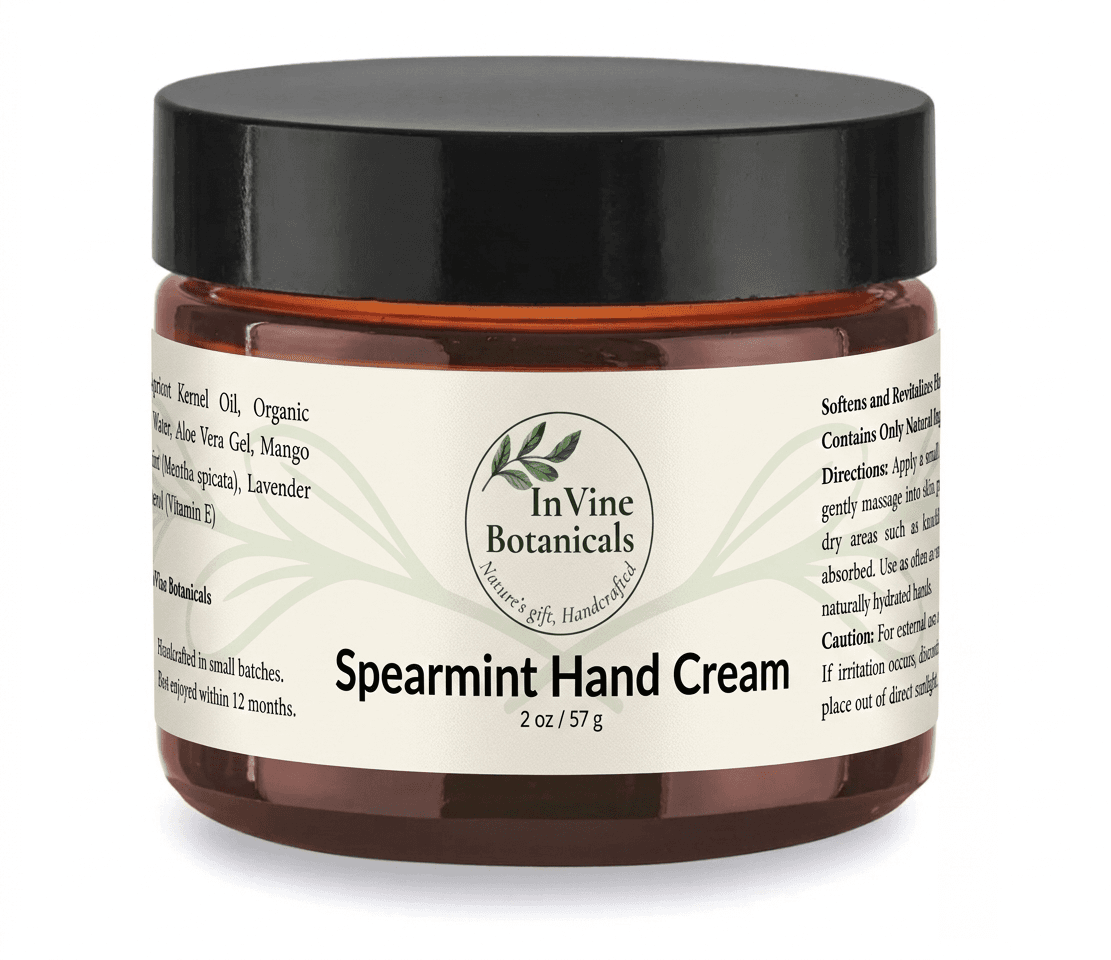
Our Spearmint Hand Cream is a 1 oz glass pump bottle, filled and capped by hand in small batches, labeled with its batch number and infusion date. Spearmint from our Tallahassee garden, slow-infused 6-8 weeks in organic oils, blended with mango butter, local beeswax, lavender, and Vitamin E. No synthetic fragrance, no parabens, no fillers.
It lives well on a nightstand. For a cook, that's exactly where it belongs.
A last thought
Cooks take absurdly good care of their knives, oiled, stoned, edge-checked, stored like instruments. The hands holding them get hot water, degreaser, and a side towel.
You don't need a regimen. You need the same respect you give the steel: thirty seconds at close, thirty seconds before bed. Your hands are the first tool in the kit. Maintain them like it.
, Janice
Related reading from the InVine blog: