Tiger Balm has been a household staple in Asia since the 1870s and has spread across more than seventy countries since then. It works, or at least, the strong cooling-then-warming sensation feels like work. But when you read the ingredient list with modern eyes, the formula raises questions worth asking honestly.
What's Actually in Tiger Balm
The classic red Tiger Balm formula is roughly:
- Camphor (~25%), the active that produces the warming sensation. Almost always synthetic in mass-produced topicals; commercial camphor is manufactured from turpentine via a multi-step chemical process.
- Menthol (~10%), the active that produces the cooling sensation. Often synthesized from petrochemical precursors rather than extracted from mint.
- Cajuput oil (~7%), distilled from the Melaleuca leucadendra tree, native to Southeast Asia.
- Mint oil (~6%), typically dementholized peppermint oil.
- Clove oil (~5%), distilled from clove buds.
- Paraffin and petrolatum, the base of the balm, depending on the formulation. Paraffin is a refined petroleum product; petrolatum is petroleum jelly.
The herbal components are real. They arrive in concentrated essential-oil form, distilled in centralized batches, often blended in industrial volume. The base that holds them is petroleum-derived wax.
None of these ingredients are dangerous at the concentrations used in a topical balm. Tiger Balm has been safely applied by hundreds of millions of people for over a century. But the question worth asking is: what would the same warming-and-cooling experience feel like if you started over from whole plants instead of synthesized actives in petroleum jelly?
How Conventional Muscle Balms Actually Work
Here is something worth understanding about menthol-and-camphor balms: the experience is sensory, not biochemical.
Menthol activates TRPM8, the same cold-sensing receptor that fires when you eat a peppermint candy or step into a chilly room. Camphor activates TRPV1, the warm-sensing receptor that responds to chili peppers and hot showers. When you rub a strong menthol-camphor preparation onto sore muscles, the receptors in your skin fire intensely. Your brain interprets the firing as "something is happening here", and the sensation can genuinely change how the muscle area feels.
But the muscles themselves haven't been touched. The actives aren't penetrating to the tissue and acting on it. The skin is reporting a temperature change to the brain, that's the entire mechanism.
This isn't a knock on Tiger Balm or any topical menthol product. The sensation is real and meaningful, especially when you're stiff after a workout or a long day on your feet. It's worth understanding that the mechanism is perceptual, not pharmacological. Your body feels different, that's the value, and it's a real one.
It's also part of why some people have become interested in muscle balms made from a broader range of botanical compounds, with the warming and cooling actives arriving from whole plants rather than extracted, concentrated, and synthesized.
How Tiger Balm Compares to Other Topical Muscle Products
Tiger Balm sits in a category of topical products people reach for after a workout, a long shift, or sport-related stiffness. A few of the most common comparison points worth understanding honestly:
- Aspercreme, uses methyl salicylate (or sometimes lidocaine in newer formulations) as its active. Methyl salicylate is chemically related to aspirin and is absorbed through the skin. The FDA classifies it as an OTC topical analgesic, meaning it's regulated as a drug, not a cosmetic. The product feels more medicinal than aromatic on application.
- Bengay, also methyl salicylate-based, often blended with menthol and sometimes camphor. The base is petroleum-derived. Falls into the same OTC topical analgesic regulatory category as Aspercreme.
- IcyHot, menthol-and-methyl-salicylate combination in a petroleum base, designed to deliver both cooling and warming sensations through a single application. Same product family as Bengay.
The methyl salicylate products in that group (Aspercreme, Bengay, IcyHot) are FDA-regulated as drugs because methyl salicylate is absorbed through skin and falls under topical analgesic monograph regulations. Tiger Balm sold in the United States is also classified as an OTC topical analgesic, its higher camphor concentration is what qualifies it for that category.
A whole-herb infused muscle balm sits in a different product category entirely. It's a cosmetic, moisturizing, conditioning, aromatic, and it's not making the same regulatory claims those products make. The same TRPM8 and TRPV1 cooling-and-warming receptor activation that menthol and camphor produce in any form is happening when you apply a whole-herb balm with peppermint and ginger in it; the receptors don't care whether the menthol came from a peppermint leaf or a chemical synthesis. The difference is in what else is on your skin alongside those actives.
A Base Built on Real Oils
Look past the camphor and menthol and you reach what most of a balm actually is by volume: its base. Tiger Balm's is a petroleum jelly and paraffin base, a stable, inexpensive carrier that holds the actives against the skin and does little else. It is inert by design.
A whole-herb balm is built on the opposite premise. Muscle Revive is made on cold-pressed organic extra-virgin olive oil and unrefined coconut oil, oils rich enough to stand alone as skincare, and the same oils that slowly draw the warming character out of the ginger, turmeric, and cayenne over six to eight weeks of infusion. Because the base is the majority of what goes on your skin, it is the part worth getting right: a refined or petroleum-derived carrier extracts less from the herbs and brings nothing of its own, while a real plant oil is both the solvent and a conditioning, emollient ingredient in itself. (Why carrier oils are half the formula.)
The Herbs Behind a Botanical Muscle Balm
The plants traditionally used in topical preparations for muscle support each carry distinct aromatic profiles and long histories of use in herbal traditions around the world.
Rosemary, A Mediterranean Standard
Rosemary (Rosmarinus officinalis) has been used in topical herbal preparations across the Mediterranean for over 2,000 years. Its leaves contain rosmarinic acid, carnosic acid, and a dense profile of volatile compounds that herbalists have valued for centuries.
When rosemary is slow-infused into a carrier oil rather than steam-distilled into an essential oil, the resulting infusion contains both the volatile aromatics and a broader range of fat-soluble compounds, the kind that don't survive a high-temperature distillation step.
Ginger and Turmeric, Two Warming Roots
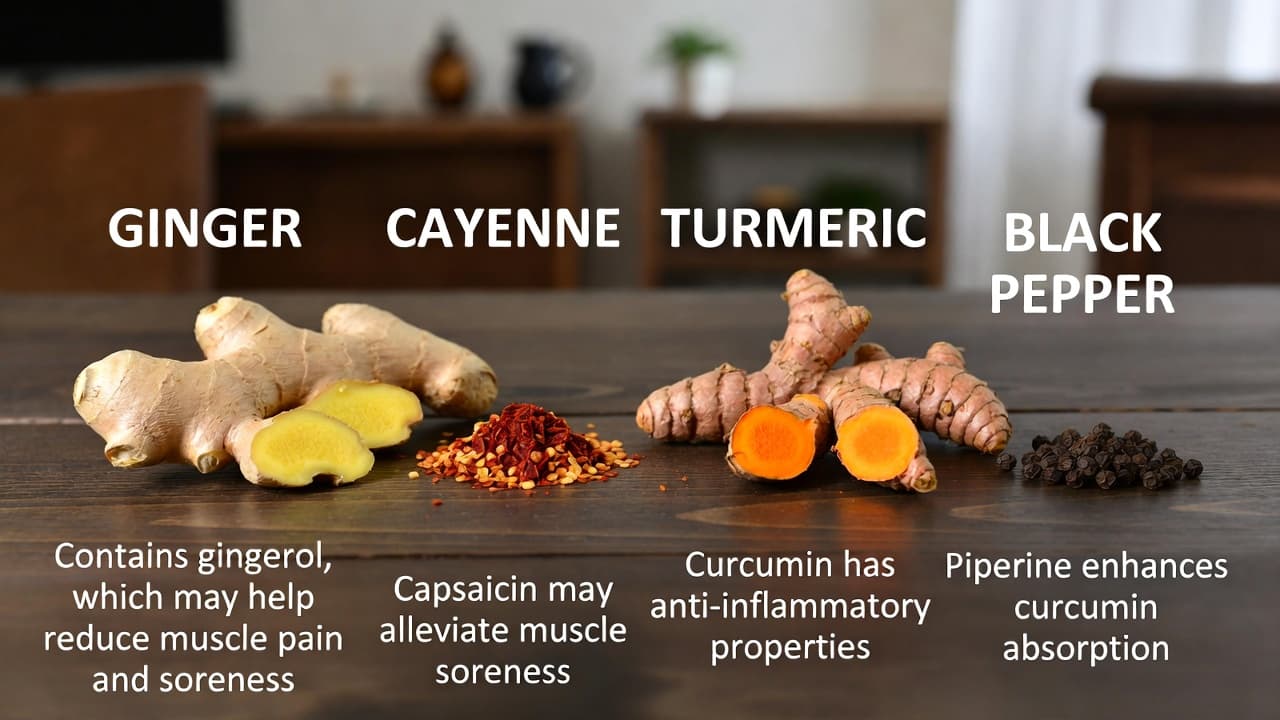
Ginger and turmeric are kitchen staples worldwide and have been used in traditional Indian and Southeast Asian herbal traditions for thousands of years. Both contain pungent compounds, gingerol in ginger, curcuminoids in turmeric, that researchers have explored extensively in topical and culinary contexts.
In an oil infusion, the warming aromatic profile of these roots transfers into the carrier slowly, producing a balm that feels different from one built around concentrated camphor. The warmth arrives gentler, layered with the earthier notes of the whole root.
Peppermint and Spearmint, The Cooling Pair
Peppermint (Mentha piperita) does contain menthol, and yes, it's the same compound found at higher concentrations in synthetic preparations. But peppermint also contains menthone, pulegone, and dozens of other terpenes that contribute to its full aromatic character. The whole leaf produces a rounder cooling sensation than isolated menthol; less sharp, more layered.
Spearmint is peppermint's gentler relative, lower in menthol, higher in carvone, the compound responsible for spearmint's characteristic sweet-cool profile. Together, the two mints contribute a depth of cooling sensation that a single concentrated extract can't match.
Cayenne, A Different Kind of Warmth
Cayenne contains capsaicin, the compound that gives hot peppers their heat and that has been investigated extensively in topical research literature. In a slow-infused balm at modest concentration, cayenne adds a subtle warming aromatic to the formula, not the searing kitchen-pepper heat, but a deeper, slower warmth.
Cayenne in a topical preparation requires careful sourcing and infusion timing. At too-high concentration it can cause skin irritation; at the right concentration in oil, it adds a quietly-present warmth that complements the rosemary-and-ginger profile.
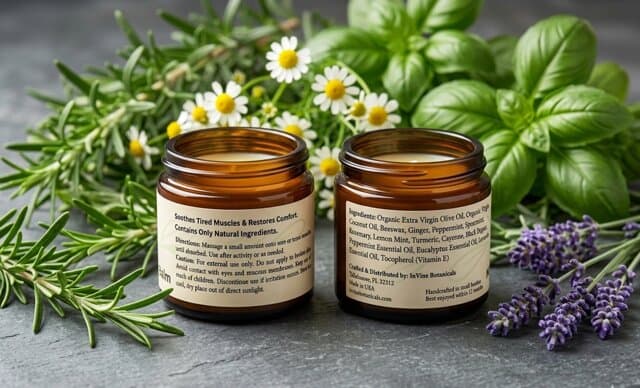
From our garden, InVine's Muscle Revive Balm is built from this set of plants. Rosemary, peppermint, spearmint, lemon mint, ginger, turmeric, and cayenne are all grown in our Florida garden and slow-infused in cold-extracted organic olive and coconut oils for six to eight weeks depending on the herb used in the infusion. The infusion is blended with beeswax from a local Tallahassee beekeeper and Vitamin E for shelf life.
No synthetic camphor. No paraffin. No petroleum.
Explore our whole-herb muscle balm →
Choosing a Muscle Balm by Use Case
Different routines call for different things. A few honest reads on when each style of balm tends to fit:
- The moment after a tough workout or training session. When muscles are still warm and "talking," many people want sharp, immediate cooling. A whole-herb balm with peppermint and spearmint delivers a similar cooling sensation, gentler in onset, but lingering longer because the aromatic compounds release gradually from the beeswax base rather than evaporating immediately.
- Daily-use applications for athletes, martial artists, climbers. Repeated daily application to the same skin areas is where the base material matters most. Petroleum-based balms can become irritating with daily use, especially on areas of high friction. A plant-oil-and-beeswax base is absorbed more cleanly and doesn't build up on the skin the way petroleum-based formulations tend to.
- Hand and forearm fatigue for gardeners, woodworkers, hobbyists. Garden hands take a real beating, soil, repetitive motions, sometimes hours of grip work. A balm that combines warming herbs (rosemary, ginger, turmeric) with cooling herbs (peppermint, spearmint) and a non-greasy plant base feels steady and gradually warming, without the medicinal smell of pharmacy-counter products.
- The end-of-day routine for chronic stiffness. When the goal is sustained aromatic warmth-and-cooling over an hour or more rather than a sharp initial blast, a beeswax-based whole-herb balm has a different character. The beeswax releases the aromatic compounds slowly; the sensation builds, peaks, and tapers off gradually rather than firing intensely and fading inside ten minutes.
The choice isn't all-or-nothing. Some people keep a synthetic-camphor product on hand for the moments when sharp and immediate is exactly what they want, and a whole-herb balm for daily routine and the moments when something gentler is the right tool.
What You're Actually Choosing Between
The choice between a synthetic-camphor petroleum-base balm and a whole-herb infused balm isn't really a question of natural vs not natural. Both are real product traditions, both have served people well, and the synthetic version delivers a faster, sharper sensation by design. Concentrated menthol and camphor in petroleum jelly will feel intense the moment you apply it.
The choice is about what kind of warming-and-cooling experience you're after, and what you're willing to put on your skin to get there.
If you've been looking for the gentler, layered, whole-herb version, built from plants you can name, traceable to a specific small-batch garden, free of petroleum and synthetic actives, this is what that looks like.
The information in this post is for educational purposes and reflects traditional herbal knowledge and published research. InVine products are cosmetics, not drugs.
Want the full picture, the formula, the method, and the most-asked questions in one place? Start with our Natural Muscle Balm guide.