Quick answer: Vaseline is excellent at one specific job, sealing skin against moisture loss. If you want a one-for-one petroleum-free occlusive, lanolin is the closest natural substitute. For everyday skin conditioning (not just sealing), beeswax-and-plant-oil balms, shea butter, squalane, or jojoba oil each do something petroleum jelly can't, they actually contribute to the skin rather than only sitting on top of it. The full nine, with use-case picks and an honest comparison table, are below.
Petroleum jelly has been in American medicine cabinets since 1872, when Robert Chesebrough patented the refined "rod wax" he had collected from oil rigs in Pennsylvania thirteen years earlier. It works. It does the specific job it was designed to do: form an occlusive seal on skin and reduce moisture loss. For more than 150 years, it has been the default answer for cracked lips, dry hands, and rough heels in households across the world.
But when you read what petroleum jelly actually is and how it functions on skin, the question of whether it belongs in everyday skincare gets more interesting.
What's Actually in Vaseline
Vaseline contains a single ingredient: petrolatum.
Petrolatum is a semi-solid mixture of saturated hydrocarbons derived from crude petroleum. The story of how it became a household product is worth knowing. In 1859, a 22-year-old chemist named Robert Chesebrough was watching workers at a Titusville, Pennsylvania oil rig scrape a waxy buildup off the drilling rods. The rig workers had been using the goo informally on cuts and burns, claiming it helped them recover faster. Chesebrough collected samples, brought them back to a Brooklyn laboratory, spent eleven years figuring out how to refine the raw rod wax into a clean, white, neutral jelly, and patented the result in 1872 as "Wonder Jelly," later renamed "Vaseline."
The refining process today is more elaborate but produces the same basic substance: petroleum is fractionally distilled, the heavier hydrocarbon fractions are dewaxed and decolorized, and the resulting jelly is purified to pharmaceutical grade. Pharmaceutical-grade petrolatum is regulated by the FDA as a skin protectant ingredient. It's safe, the safety record over a century and a half is genuinely solid.
What it isn't is botanical. The substance in the jar started underground millions of years ago as marine organisms, was compressed into oil over geological timescales, was extracted from a well, and was processed through an oil refinery before reaching a tube of skincare. The plant world has nothing to do with it.
Trying the overnight routine without petroleum? See our guide to natural slugging.
How Occlusive Skincare Actually Works
Vaseline doesn't moisturize the way most people think. It doesn't add moisture to skin. It seals existing moisture in.
When you apply petrolatum to skin, the hydrocarbon molecules form a continuous, water-impermeable film on the stratum corneum, the outermost layer of skin. This film reduces transepidermal water loss (TEWL) by up to 98%. The water already in your skin can't evaporate out. Whatever moisture is present stays present.
This is genuinely useful for very specific situations. Severely cracked skin benefits from that barrier while the skin underneath does its own work. Cold-weather lip protection benefits from a non-evaporating film. Post-procedure skin (after a chemical peel or biopsy, for instance) is often occluded with petrolatum during the recovery window.
But occlusion is the entire mechanism. Nothing penetrates the petrolatum layer. Nothing transfers from the petrolatum into your skin. The petrolatum itself contains no botanical compounds, no antioxidants, no fatty acids your skin can incorporate, no nutritive components. It's a passive seal, and a complete one.
It also doesn't discriminate about what it traps. The seal works in both directions: moisture can't leave, but anything on the skin surface, sweat, sebum, environmental particles, fragrance from your shampoo, gets pressed against the skin under the occlusive layer until you wash it off.
When Vaseline Is the Right Tool
It would be dishonest to say Vaseline is bad. It is genuinely good at occluding skin, and there are real situations where pure occlusion is exactly what you need:
- Severely cracked skin, heels, knuckles in winter, a thumb-tip that has split. The crack benefits from being sealed against external dryness while the skin underneath does its own work.
- Post-procedure recovery, dermatologists routinely include petrolatum after chemical peels, laser treatments, or skin biopsies. The occlusive film is part of the recovery routine, providing a barrier without introducing potential irritants.
- Extreme cold lip protection, wind and freezing temperatures pull moisture from lip skin faster than any conditioning product can replenish. An occlusive film is more effective than any moisturizing balm in those conditions.
- Diaper area, petrolatum's water-impermeability creates a barrier between skin and urine. Not glamorous, but mechanically sensible.
If you have been using Vaseline for any of those reasons, you are using it correctly. The right tool for the job is the right tool. The question is whether it's the right tool for everyday skincare.
What You Lose with Everyday Vaseline Use
In 2022 and 2023, a TikTok-driven trend called "slugging", applying petroleum jelly to the face overnight as the final step of a skincare routine, went viral. The premise is that the occlusive layer locks in whatever serums or moisturizers you applied earlier, maximizing their effect over the eight hours you sleep.
For some people, with some skin types, in some climates, this works. For others, it doesn't. The reasons are worth understanding.
When you sleep with petrolatum on your face, the seal traps every other thing on your skin's surface against the skin for eight hours. Sebum continues to be produced overnight; trapped under petrolatum, it pools rather than dispersing. If your earlier-applied products contained fragrance, surfactants, or active ingredients, they are pressed into the skin at concentration for an extended duration. Any environmental particulate already on the face is similarly held in place.
The TikTok-trend reports of "slugging gave me clearer skin" and "slugging gave me a breakout" come from the same mechanism, occlusion intensifies whatever is already happening, both helpful and unhelpful.
This is the broader limitation of occlusive everyday skincare: the skin is not being fed. There are no botanical compounds entering through the petrolatum layer, no fatty acids your skin can incorporate into its lipid bilayer, no antioxidants providing surface-level support. Petrolatum supports the barrier passively. Everything else has to come from elsewhere in your routine, or has to come from a different product class entirely.
Where a petroleum base brings nothing of its own, a cold-pressed plant oil is both a barrier and an ingredient: organic olive oil carries oleic acid and its own antioxidant polyphenols, while coconut oil adds skin-conditioning medium-chain fats. That is the real thread behind most of the alternatives below, not simply "petroleum-free," but a base that conditions skin instead of only sealing it. (Why the carrier oil is half the formula.)
9 Natural Alternatives to Vaseline and Petroleum Jelly
What follows is a category-by-category honest read on the alternatives. None of them are "the new Vaseline", they each do a slightly different job, and the right pick depends on what you wanted Vaseline to do in the first place.
1. Lanolin
The closest "natural Vaseline." Lanolin is a wax secreted by sheep to waterproof their wool, when refined for skincare, it's a semi-solid, slightly tacky substance that occludes very effectively. Used by nursing mothers for nipple care, by hikers for face protection in extreme cold, by some skincare brands (Lanolips, Bag Balm) as the base of lip and hand products. The most direct one-for-one petroleum-jelly substitute when pure occlusion is the goal.
Best for: cracked lips, knuckles, areas where pure occlusion is the point
Trade-off: smell and texture aren't for everyone; people with wool sensitivities may react
2. Beeswax + Plant Oil Balm
A traditional approach used across cultures for thousands of years. Beeswax forms a flexible, semi-permeable film that reduces moisture loss while still letting skin function. When combined with plant oils like olive, coconut, or jojoba, and especially when those oils have been slow-infused with whole herbs, the balm delivers conditioning along with light occlusion.
Best for: daily skin conditioning, post-wash hand care, areas where skin shouldn't be fully sealed
Trade-off: not as occlusive as petrolatum in extreme cold conditions
3. Shea Butter
A solid plant butter from the karite tree, traditional in West African skincare for centuries. Shea melts at body temperature, penetrates the upper layers of skin, and contains stearic acid, oleic acid, and vitamin A precursors. Raw shea has a faint nutty aroma; refined shea is closer to odorless.
Best for: dry hands, elbows, knees, rough skin patches
Trade-off: softer than petrolatum; doesn't provide the same level of cold-weather sealing
4. Cocoa Butter
Solid at room temperature, melts on contact with skin, derived from the same plant as chocolate. Used for skin conditioning in Caribbean, South American, and West African traditions. The aromatic profile is distinct, true cocoa butter smells like chocolate at room temperature, fading once applied.
Best for: dry skin in general, stretch-mark routines, body conditioning
Trade-off: can be heavy on facial skin for some skin types
5. Squalane (Plant-Derived)
A lighter, faster-absorbing oil similar in molecular structure to the squalene your skin naturally produces. Commercially derived today from olives, sugarcane, or rice bran. Behaves more like a serum than an occlusive, and increasingly used in "slugging" routines as a non-petroleum alternative for people who want the locking-in effect without the full petroleum seal.
Best for: facial slugging, lightweight overnight conditioning
Trade-off: doesn't seal as completely as petrolatum, by design
6. Spearmint Hand Cream
For daily hand conditioning specifically, InVine's Spearmint Hand Cream is built around a slow infusion of spearmint grown in our Tallahassee garden. The cream is a different format from petroleum jelly: lighter, absorbs more cleanly, and contains plant compounds that the petrolatum-based hand creams simply don't have access to.
Best for: post-wash daily hand care, gardener hands, dry hands from frequent hand washing
Trade-off: lotion format, not occlusive, won't seal a deep crack
7. Whole-Herb Beeswax Balm
When you want the conditioning that comes with whole-herb infusion and the light protective film that beeswax gives, this is the category. InVine's whole-herb balm catalog, bug-bite, breathe-free, muscle-revive, all sit in this product class. The carrier oil has been slow-infused with herbs for six to eight weeks, the beeswax structures the balm into a soft solid, and the result conditions skin while providing light barrier protection.
Best for: people who want plants in their skincare and a balm format
Trade-off: scent is aromatic by design; not for fragrance-averse routines
8. Calendula-Infused Olive Oil
A traditional preparation across European and Mediterranean herbalism, calendula petals slow-infused in olive oil produce a golden, gentle oil long used in skin care for sensitive areas. Available as a stand-alone oil or as the base of various balms. One of the most historically established preparations in Western herbal skincare.
Best for: sensitive skin, baby skin, areas that need gentle conditioning
Trade-off: oil format means it doesn't stay localized like a balm or jelly
9. Jojoba Oil
A liquid wax (not a true oil) pressed from desert shrub seeds, structurally similar to human sebum. Penetrates skin smoothly, doesn't oxidize quickly, doesn't clog pores at typical use levels. Used as a carrier oil and as a standalone facial oil.
Best for: facial skincare, light hand conditioning, oils that resist going rancid
Trade-off: non-occlusive, won't provide barrier protection in extreme cold
Quick Comparison Table
| Alternative | Occlusion | Conditioning | Plant-Based | Best Use Case |
|---|
| Lanolin | High | Light | No (animal) | Cracked lips, knuckles |
| Beeswax + plant oil balm | Medium | High | Yes | Daily conditioning |
| Shea butter | Medium | High | Yes | Dry hands, elbows |
| Cocoa butter | Medium | High | Yes | Body, stretch marks |
| Squalane (plant) | Low | Medium | Yes | Facial slugging |
| Spearmint Hand Cream | Low | High | Yes | Daily hand care |
| Whole-herb beeswax balm | Medium | High | Yes | Plant-based daily skin |
| Calendula-infused olive oil | Low | High | Yes | Sensitive / baby skin |
| Jojoba oil | Low | Medium | Yes | Facial / light care |
The Whole-Herb Approach in Practice
The plant world has been giving humans skincare ingredients for thousands of years. Olive and almond oil for dry skin in the Mediterranean. Coconut and sesame in tropical traditions. Beeswax, collected from honeybee colonies, as a balm structural agent across cultures.
These materials work differently from petrolatum. They are also somewhat occlusive, but more lightly. Beeswax in particular forms a flexible, semi-permeable film that reduces moisture loss while still allowing the skin to function normally. Organic carrier oils, olive, coconut, jojoba, penetrate the stratum corneum to varying depths, integrating with the skin's natural lipid structure rather than sitting on top of it.
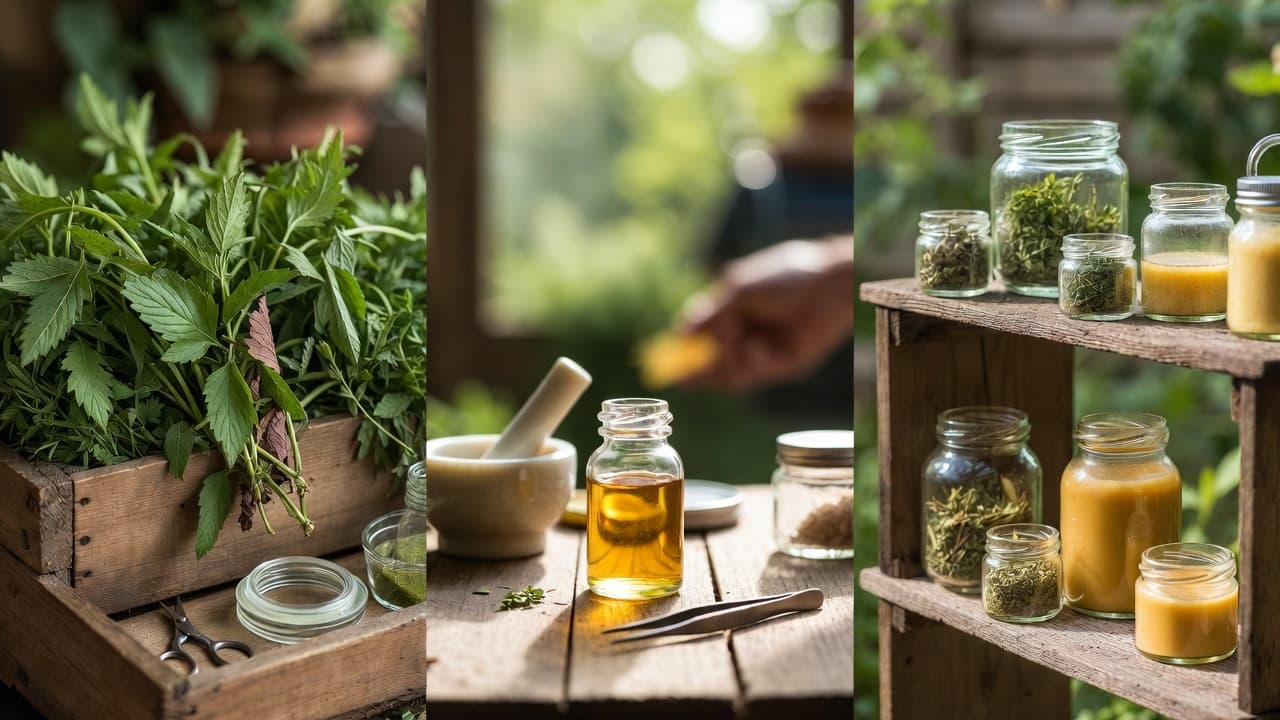
When the carrier oil has been slow-infused with whole herbs, left in cool, dark conditions for six to eight weeks while the plant material releases its fat-soluble compounds, the resulting infusion contains both the carrier and the botanical fraction. Rosmarinic acid from rosemary. Carvone and menthone from mint. Curcuminoids from turmeric. Each compound has its own profile, its own aromatic character, its own history of use.
Slow-infused herbal balms aren't trying to do what Vaseline does. They are doing a different job: conditioning skin while delivering plant compounds, with light occlusion from beeswax rather than complete sealing from petroleum. The film is permeable enough to let skin function as designed; the oils underneath condition; the herbs add what plants have always added to skincare.
From our garden, InVine's whole-herb balms and creams are built from plants we grow in our Florida garden and slow-infuse for six to eight weeks in cold-extracted organic olive and coconut oils. Each finished product is blended with beeswax from a local Tallahassee beekeeper and Vitamin E for shelf life.
We don't make a Vaseline replacement. We make products that do a different job. If you've been reaching for Vaseline because it was the only thing in the bathroom and you wanted something on your hands, your knuckles, your shins after a shower, what you actually wanted was to condition the skin and add some softness back. That's what whole-herb infusions are for.
Explore our whole-herb balm catalog →
What You're Actually Choosing Between
Petroleum jelly and whole-herb infusion are not in competition for the same skincare slot. They are tools for different jobs, and pretending otherwise would be dishonest.
If you have severely cracked skin, a post-procedure recovery situation, or a wind-blasted set of lips in February, Vaseline is doing something specific that an herbal balm doesn't try to do. Use Vaseline. The occlusion is the right answer.
Petrolatum shows up across product categories, not only as a barrier cream but also as the base of chest balms like Vicks VapoRub, which uses the same petroleum suspension to hold concentrated menthol and camphor. We covered that category in our look at natural alternatives to Vicks VapoRub. Its closest household sibling, Aquaphor, 41% petrolatum blended with humectants, gets the same treatment in our guide to natural alternatives to Aquaphor. So does the dermatologist-shelf favorite CeraVe Healing Ointment, which runs 49.5% petrolatum beneath its ceramide label.
If you have been reaching for Vaseline as your default because it was the household cure-all your grandmother kept in the medicine cabinet, and what you actually want is daily skin conditioning, light protection, and the comfort of having something on your skin that includes plants instead of refined hydrocarbons, that is a different choice, and the alternatives have always existed. They have just been quieter than Vaseline's century-and-a-half of marketing.
The information in this post is for educational purposes and reflects traditional herbal knowledge and published research. InVine products are cosmetics, not drugs.