Walk into any drugstore and the muscle balm shelf looks almost identical: every tube and tin promises warming or cooling, and most rely on the same handful of synthesized actives in a petroleum or paraffin base. The herbs, when they appear at all, are usually fragrance-grade essential oils, not the herbs themselves.
If you're looking for an herbal balm for sore muscles that actually carries the herb, you have to know what the label is telling you, and what it's leaving out.
Whole-herb infusion vs. essential-oil dilution
Most "herbal" muscle balms on the market are essential-oil-diluted. A small percentage of menthol, eucalyptol, or capsaicin oil is dropped into a synthetic or petroleum base, and the result is shelf-stable, cheap to produce, and chemically a long way from the original plant.
Whole-herb infusion is a different process entirely. The actual plant material, leaves, root, peel, is steeped in cold-pressed organic carrier oils for six to eight weeks in cool, dark conditions, never in the sun. Over that time, the full range of fat-soluble compounds the plant carries, not just the volatile aromatic ones, moves into the oil. The infused oil is then strained, blended with beeswax to set the structure, and blended with vitamin E to protect the formula from oxidation.
The two products feel different on the skin. The two products are different at the molecular level. A whole-herb infusion carries the resins, the waxes, the fat-soluble polyphenols, the parts of the plant that don't show up when you isolate a single essential oil.
It's the same difference as the juice from one orange and a glass of water with three drops of orange flavoring in it. Both will taste of orange. Only one is the orange.
What to look for on the label
A label worth your money will tell you specifically:
The carrier oils, by name. Whole-herb infusions are only as clean as the oil they're built on. Look for "organic olive oil," "organic coconut oil," "apricot kernel oil", named oils, not the vague "vegetable oil" or "fragrance carrier." If a label can't say what the base is, it usually doesn't want you to know.
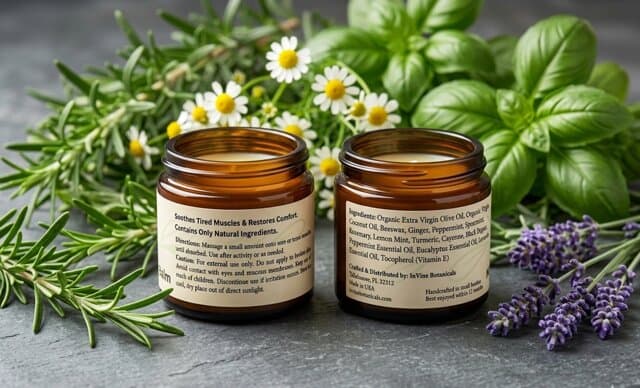
The herbs, by name. "Herbal blend" tells you nothing. The plants traditionally reached for in topical muscle preparations are well documented, rosemary, ginger, turmeric, cayenne, peppermint, spearmint. A balm whose maker stands behind what's in it will name them.
A traceable batch. Small-batch makers print a batch number and an infusion date on every jar, so the product can be matched back to the moment its herbs were harvested. Mass-produced muscle rubs don't do this. Most of them can't.
Nothing that doesn't belong. No alcohol, no parabens, no synthetic fragrance, no petroleum derivatives. None of those belong in something you're rubbing into skin you're trying to support, not strip.
The plants that have been reached for, traditionally
Across centuries of folk and household herbalism, a small set of plants kept showing up in topical muscle preparations. These are descriptions of plants, not claims about what a finished product does.
Rosemary has a sharp, evergreen scent and a long traditional association with topical preparations after physical work. It carries rosmarinic acid, a polyphenol researchers have studied for its antioxidant profile.
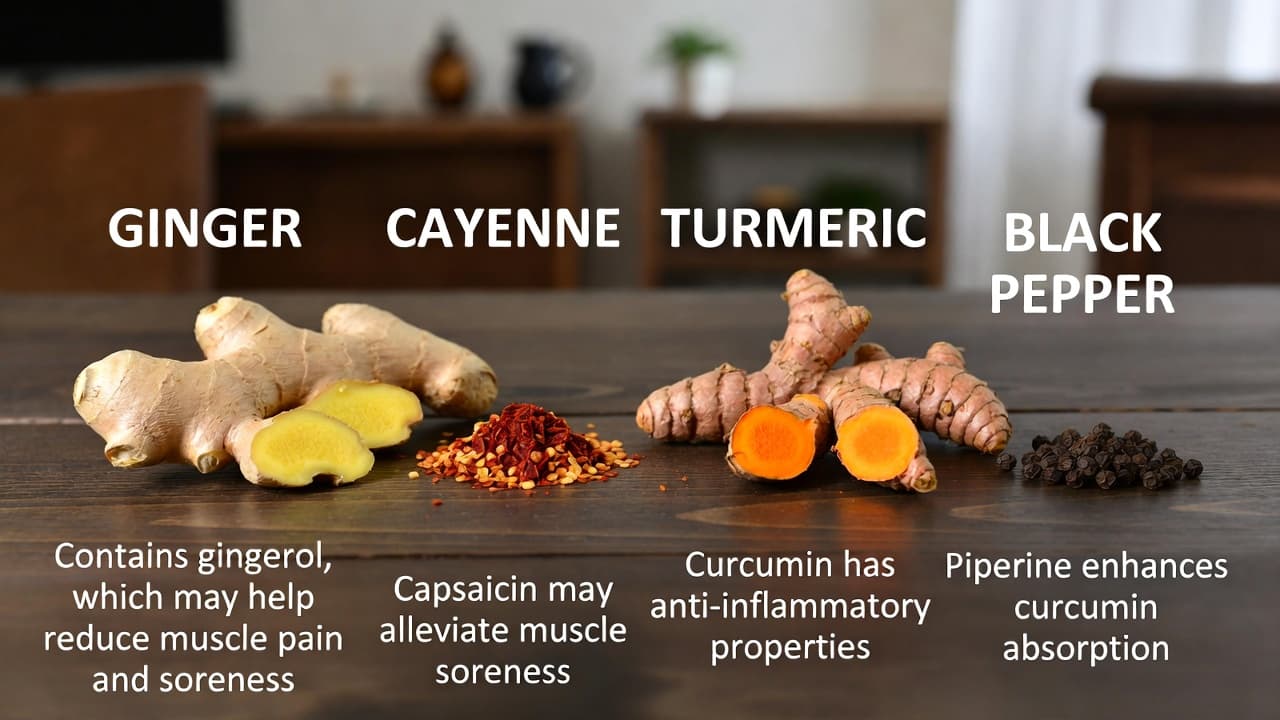
Ginger and turmeric are warming root spices with a long history in traditional household formulations across South and Southeast Asia. Both deliver a sensory warmth on the skin that's distinct from menthol's cool.
Cayenne is the source of capsaicin, the same compound that gives chili peppers their heat. Topically it produces a recognizable warming sensation.
Peppermint and spearmint carry menthol and carvone respectively, the cool counterpoint to cayenne's warm. The two paired together create a sensation that walks back and forth between hot and cool, which is why traditional sports liniments often pair warming and cooling herbs in the same formula.
The point isn't that any of these is a miracle plant. The point is that a real herbal muscle balm has actual, named herbs in it, not a synthesized stand-in.
What we grow, and why Florida matters
Everything in our whole-herb muscle balm, rosemary, ginger, turmeric, cayenne, peppermint, spearmint, lemon mint, is grown by hand in our Tallahassee, Florida garden. Year-round.
The subtropical climate is what makes that possible. Ginger and turmeric in particular are tropical plants that struggle in a northern garden but thrive in our soil for nine months of the year. A turmeric root pulled at peak from a Florida bed in October carries a different fat-soluble profile than one shipped in dried from across an ocean. The same is true for ginger, for cayenne, for every herb we pull at peak and infuse within days.
Slow infusion in cool, dark conditions. Small batches, never stockpiled. Hand-poured, hand-capped, with a printed label on every jar marking its batch number and infusion date, so every formula is traceable back to the day its herbs left the garden.
If you're shopping for an herbal balm for sore muscles and you want to know exactly what's in the jar and where it came from, that's what we're here for.
Want the full picture, the formula, the method, and the most-asked questions in one place? Start with our Natural Muscle Balm guide.