When you reach for a warming balm after a hard workout or a long day, you want something that delivers a genuine warming sensation, not just something that smells like menthol and fades in five minutes. Real botanical warmth comes from plants with centuries of traditional use, and four of the most valued are already in your spice cabinet.
1. Ginger (Zingiber officinale)
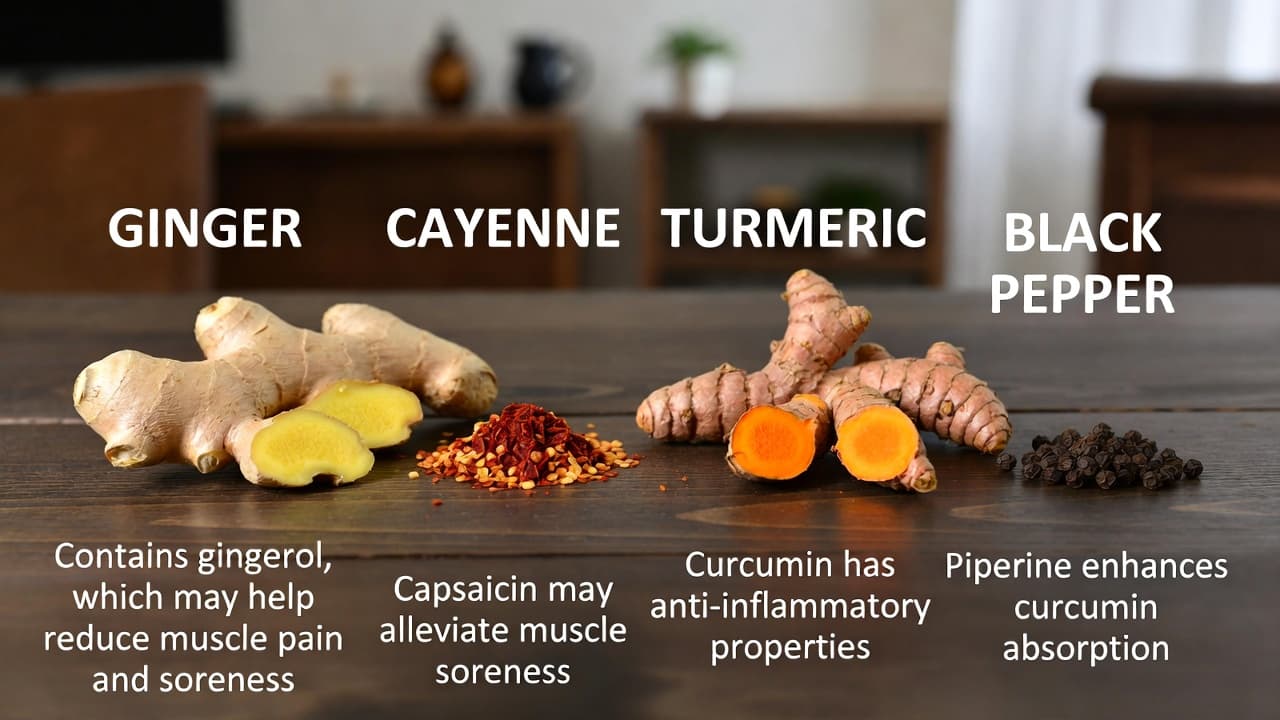
Ginger's warming effect comes primarily from gingerols in fresh root and shogaols in dried or heated root. These compounds have been extensively studied by researchers, and ginger has been one of the most valued warming herbs in Ayurvedic, Chinese, and European herbal traditions for thousands of years.
Traditionally, ginger was applied topically as a poultice or compress, and it remains one of the most commonly used warming botanicals in herbal preparations worldwide. Research has explored gingerols and shogaols for a range of properties, making ginger one of the best-characterized spice-cabinet herbs in the scientific literature.
The warmth you feel is real: gingerols activate TRPV1 receptors, the same heat-sensing ion channels that respond to physical warmth. Your skin interprets the stimulation as genuine heat, creating a deep, satisfying warming sensation.
2. Cayenne (Capsicum annuum)
Cayenne is the most intensely warming herb in the formula. Its active compound, capsaicin, creates a strong warming sensation by stimulating TRPV1 receptors at the skin's surface, the same heat-sensing receptors that respond to physical warmth.
Cayenne has been used in traditional herbal preparations across Central American, South American, and Asian herbal traditions for centuries. It was historically one of the most valued warming botanicals, and it remains among the most recognized. The warming sensation from capsaicin in a carrier oil is gradual and sustained, creating a deep warmth that builds slowly rather than arriving all at once.
Many people who enjoy warming balms regularly find that the experience is most satisfying with consistent use, the sensation becomes familiar and the ritual itself becomes part of the appeal.
3. Turmeric (Curcuma longa)
Turmeric contributes something the other warming herbs don't: curcuminoids, particularly curcumin, which are among the most extensively studied botanical compounds in the world. Researchers have published thousands of papers exploring curcumin's properties, making it one of the most well-characterized plant compounds in the scientific literature.
Turmeric has been a cornerstone of Ayurvedic herbal tradition for thousands of years, and it remains one of the most valued botanicals in traditional practices worldwide. When infused into a fat-soluble carrier oil, the curcuminoids are drawn out over weeks of slow extraction, creating a deeply golden, richly aromatic oil.
The golden color of turmeric is a visual reminder of how concentrated the curcuminoids are in even a small amount of root.
4. Black Pepper (Piper nigrum)
Black pepper's role in this formula is partly direct and partly synergistic. Piperine, the compound responsible for pepper's sharp taste and warmth, adds its own warming sensation while complementing the other botanicals.
Piperine is also a well-known bioavailability enhancer. In oral supplements, it dramatically increases curcumin absorption. Applied topically alongside turmeric, research has explored similar synergistic activity, with piperine potentially facilitating the penetration of curcuminoids into deeper skin layers.
Why Combination Matters
These four plants each bring a distinct warming character and botanical profile:
- Ginger, deep, building warmth from gingerols and shogaols
- Cayenne, intense, sustained heat from capsaicin
- Turmeric, golden richness from curcuminoids, one of the most studied botanical compounds
- Black pepper, sharp warmth from piperine, with potential synergy alongside turmeric
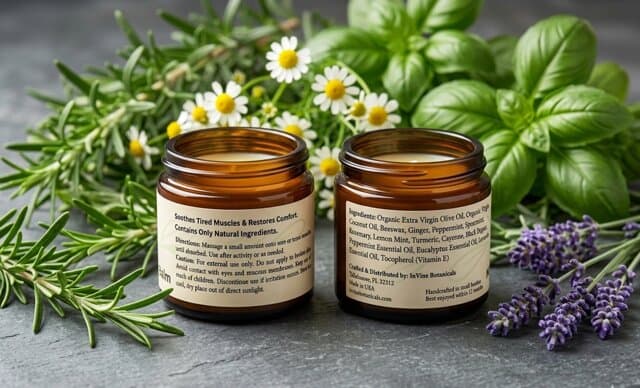
No single herb creates this full range of sensation. Together, they produce a layered, complex warming experience, which is why a well-formulated multi-herb warming balm like Muscle Revive Balm tends to feel more satisfying than any single-ingredient preparation.
The slowest part of the process is the most important: weeks of cold/dark oil infusion give these plant compounds time to fully migrate into the carrier, producing a base that's genuinely botanical, not just a carrier oil with a few drops of spice oil stirred in at the end.
Want the full picture, the formula, the method, and the most-asked questions in one place? Start with our Natural Muscle Balm guide.