Florida Spring Is Beautiful. The Bugs Are Not.
If you've lived in Florida long enough, you know the ritual. Sometime in late February, the azaleas start to bloom, the air turns that perfect golden-warm, and you think — this is why I live here. Then you step outside for five minutes and come back in looking like you lost a fight with something invisible.
Mosquitoes, no-see-ums, gnats, sand flies, deer flies — Florida has a full cast of characters, and spring is when the season truly opens. As an herbalist growing a garden here in Tallahassee, I've spent years thinking carefully about this. Not from a pharmaceutical angle, but from a botanical one: what has human tradition — and modern curiosity — told us about the relationship between plants, scent, and insects?
This post is my deep dive into that question. I'll walk you through what actually bites you in Florida spring, the aromatic chemistry behind why certain plants have been historically associated with insect deterrence, how I use that knowledge in my own garden and products, and some practical habits that can make your outdoor time genuinely more enjoyable.
This is educational, not medical. And it's cosmetic, not pharmaceutical. But I think you'll find it genuinely useful.
What's Actually Biting You in Florida Spring
Before we talk about plants, it helps to know your opponent.
Mosquitoes are the obvious culprit. Florida has around 80 species of mosquitoes — more than almost any other state. Spring rains create the standing water they need to breed, and warm temperatures mean they're active earlier in the day than you might expect. The Aedes aegypti and Aedes albopictus (Asian tiger mosquito) are both aggressive daytime biters, which surprises people who assume mosquitoes are only a dusk-and-dawn problem.
No-see-ums (biting midges, Culicoides spp.) are arguably more maddening. They're small enough to pass through standard window screens, they swarm in coastal and low-lying areas, and their bites can leave intensely itchy welts disproportionate to their size. They're most active during calm wind conditions at sunrise and sunset.
Deer flies and horse flies become more active in spring, especially near wooded areas and water. They're larger, they bite hard, and unlike mosquitoes, they don't respond much to the same deterrents.
Sand gnats are common in North Florida and the Panhandle, particularly in sandy, humid environments — which is, of course, most of Florida.
Knowing which insect is bothering you matters because different insects respond differently to environmental conditions and botanical aromas. What deters a mosquito may have no effect on a deer fly.
The Aromatic Chemistry of Insect Deterrence
Here's where I get genuinely excited, because this is where botany and entomology overlap in fascinating ways.
Insects locate hosts through a complex combination of signals: carbon dioxide, body heat, lactic acid, and — critically — scent compounds on the skin. Mosquitoes in particular are remarkably sensitive to volatile organic compounds. This is why some people seem to attract more mosquitoes than others; individual body chemistry, including the microbial communities on skin, produces different scent profiles.
Aromatic herbs produce volatile compounds — terpenes, phenolics, aldehydes — that appear to interfere with or mask those host-locating signals. This is the basis for centuries of traditional use of fragrant plants as part of outdoor life in warm climates.
Let me walk you through some of the botanicals I grow right here in my Tallahassee garden and what research has explored about their key compounds:
Lemongrass
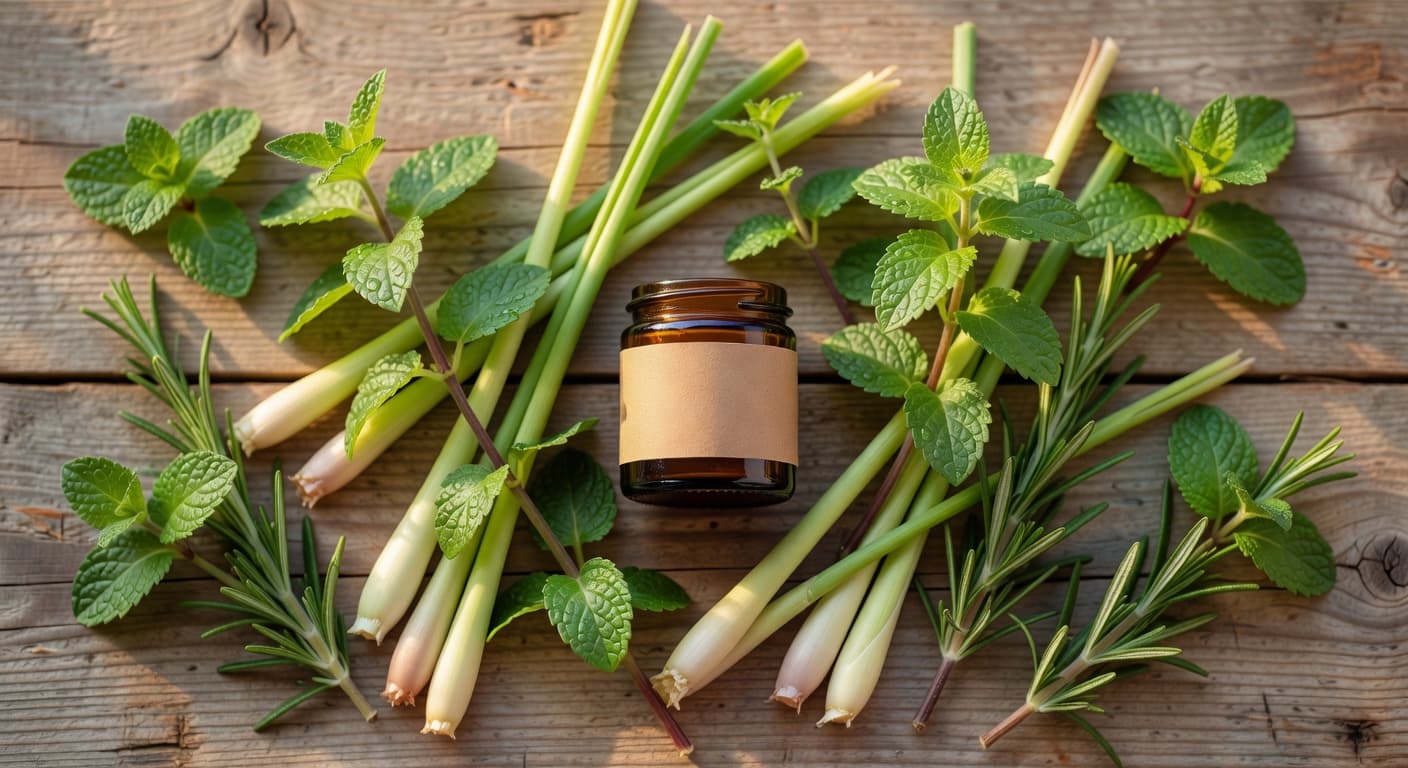
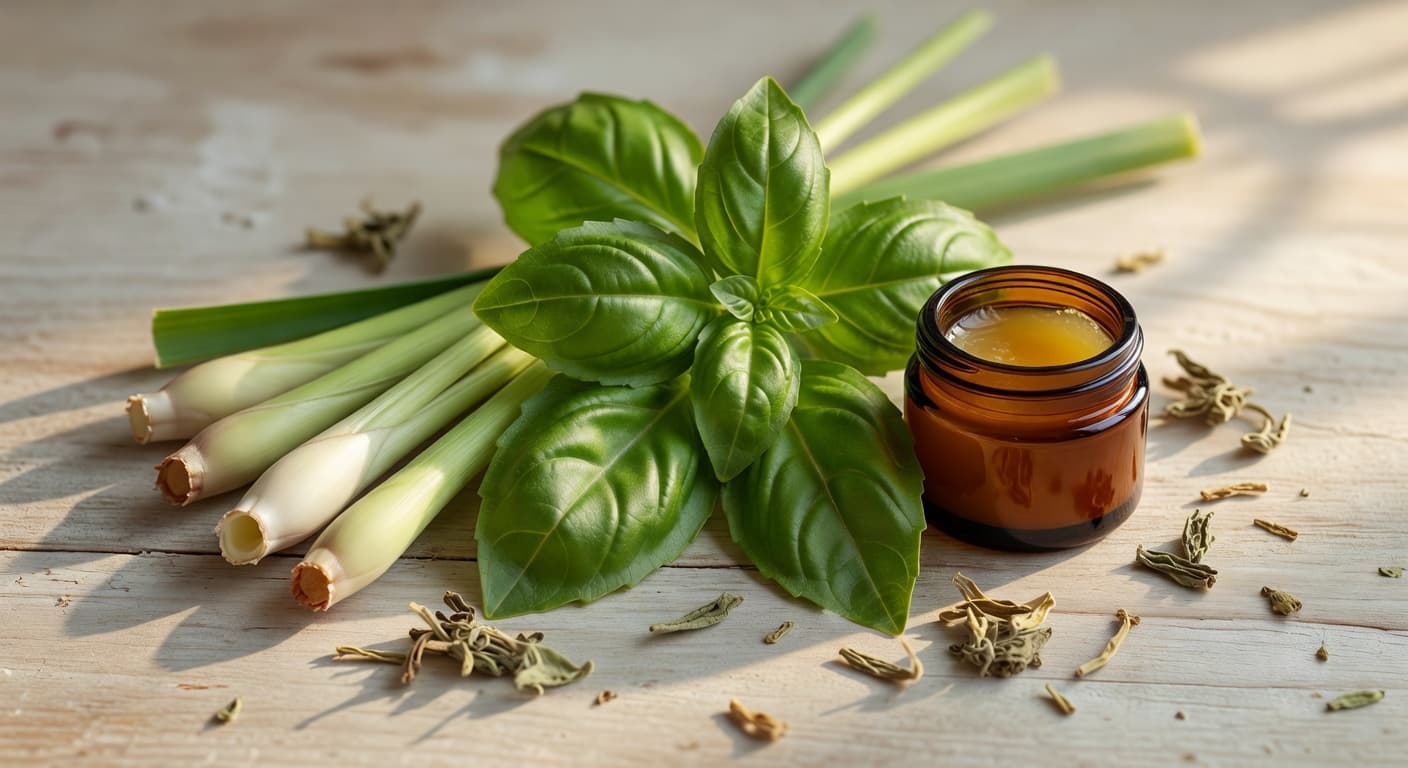
Lemongrass contains high concentrations of citral (a blend of geranial and neral) and citronellal — the same compound family responsible for the well-known insect-deterring properties of citronella. Research has explored citral and citronellal for their effects on insect olfactory responses. Traditionally, lemongrass has been used across Southeast Asia and tropical cultures as part of outdoor and garden life for generations. The scent is bright, citrusy, and genuinely lovely — one of my favorite things growing in the garden.
Lemon Balm
Lemon balm (Melissa officinalis) is rich in citronellal and also contains rosmarinic acid. The fresh leaves, when crushed, release a strong lemon-citrus aroma that has long been associated in folk herbalism with keeping insects at a distance. Research has explored the volatile compounds in lemon balm for various biological activities. I grow masses of it — it spreads enthusiastically in the Florida heat and is one of the first herbs to bounce back in spring.
Rosemary
Rosemary is rich in 1,8-cineole, camphor, and alpha-pinene. Research has explored these terpenes in the context of insect behavior. Traditionally, rosemary smoke was used in Mediterranean cultures to keep insects away during outdoor meals and gatherings. As a topical botanical in a slow-infused oil, rosemary brings both its distinctive resinous aroma and the general skin-conditioning properties that make it a valued cosmetic herb.
Peppermint
Peppermint contains menthol as its primary volatile compound. Research has explored menthol and peppermint oil in studies looking at insect responses to aromatic compounds. Menthol produces a well-known cooling sensation on skin — which many people find refreshing during Florida's warm spring days in its own right. Traditionally, mint family plants have a long association with outdoor use across many cultures.
Basil (Holy and Sweet)
Both holy basil and sweet basil are rich in eugenol and linalool. Research has specifically explored eugenol in insect studies. Traditionally, basil has been grown near doorways and outdoor seating areas in tropical cultures for centuries — a practice that makes a lot of sense when you understand its aromatic chemistry. I grow several basil varieties in my garden, and they thrive in the Florida heat.
Whole-Herb Infusion: Why It Matters for This Application
When I formulate the Bug Bite Balm, I'm not working with isolated essential oils diluted into a base. I'm slow-infusing whole plant material — stems, leaves, the full botanical — directly into carrier oils using a cold, dark infusion method. This is a meaningful distinction.
Essential oils are highly concentrated volatile extracts. They're powerful, but they represent only one fraction of what a plant contains. Whole-herb infusion captures a broader range of the plant's compounds: the fat-soluble constituents, the waxy surface compounds, the full aromatic profile — in a more gentle, balanced concentration that works beautifully for a leave-on cosmetic application.
The resulting infused oil carries the authentic scent of the herbs — not the sharp, clinical punch of an essential oil, but something softer and more complex. It also carries the skin-conditioning properties of the carrier oils themselves: the moisturizing depth of olive oil, the skin-softening quality of coconut oil, and the antioxidant support of vitamin E.
This is what I mean when I talk about a botanical approach versus a chemistry-lab approach. It's rooted in tradition, refined by herbalist knowledge, and made by hand here in Florida.
Practical Habits for Florida Bug Season
Beyond what you apply to your skin, there are environmental and behavioral practices that make a genuine difference during Florida spring.
Eliminate standing water around your property. Mosquitoes can breed in as little as a bottle cap of water. Birdbaths, plant saucers, clogged gutters, tarps with pooled rainwater — all of these are breeding sites. The Florida Department of Health consistently identifies source reduction as the most effective long-term approach to managing mosquito populations on your property.
Time your outdoor activities thoughtfully. Aedes mosquitoes are most active in early morning and late afternoon. No-see-ums are worst at dawn and dusk when wind is calm. Deer flies peak in mid-morning on warm days. Avoiding peak activity windows — especially in dense vegetation or near standing water — makes a real difference.
Wear light-colored, loose-fitting clothing. Research has shown that dark colors attract more mosquitoes. Loose-fitting clothing with long sleeves and pants creates a physical barrier that no topical product can fully replicate.
Use fans. Mosquitoes are weak flyers. A fan on your porch or outdoor seating area makes it physically harder for them to land on you. This is a simple, underrated strategy.
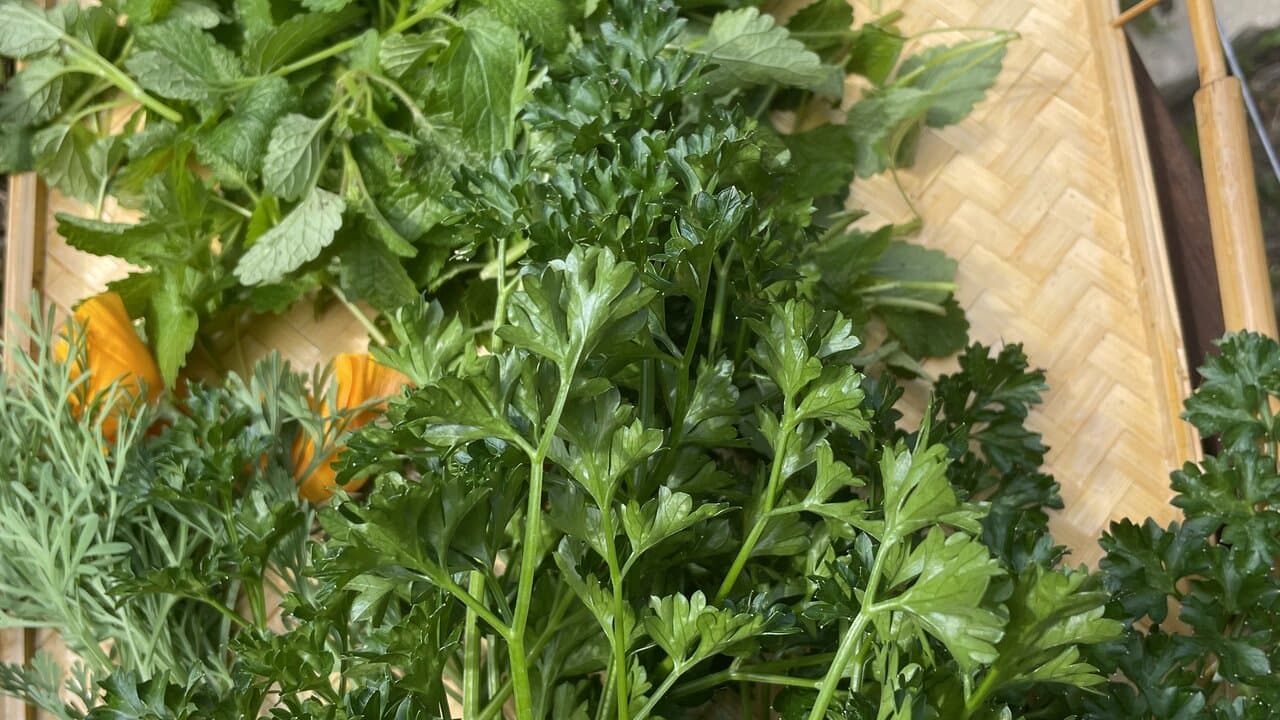
Grow aromatic herbs strategically. I keep potted lemongrass, rosemary, basil, and lemon balm near my outdoor seating. Brushing against them releases their volatile compounds into the air around you — a beautiful, fragrant layer of the garden as a living part of your outdoor environment.
Shower after outdoor activity. Lactic acid and other metabolic compounds on skin are part of what attracts mosquitoes. Rinsing them off reduces your attractiveness to future insects.
How I Use InVine Products in My Spring Outdoor Routine
I want to be genuinely transparent here: topical cosmetic products are one layer of a multi-layered approach. No balm — mine or anyone else's — is a standalone solution for Florida bug season. But here's how I personally incorporate my products:
Before I head into the garden for my morning harvest, I apply the Bug Bite Balm to exposed skin — ankles, wrists, the back of my neck. It's infused with lemongrass, lemon balm, rosemary, peppermint, and basil, slow-infused in my own cold, dark infusion process from herbs grown right here. The scent is genuinely lovely — herbal, citrus-forward, complex — and it leaves my skin feeling soft and conditioned rather than greasy or chemical-smelling.
After time outside, if I've gotten any bites, I reach for the same balm on the affected area for a cooling, soothing sensation on the skin. The menthol from the peppermint infusion delivers that characteristic cooling feel that many people find comforting on irritated skin.
For longer outdoor excursions — a trail walk, a garden party, a morning at the farmers market — I'll reapply every couple of hours, especially if I've been sweating or washing my hands.
I also keep the Muscle Revive Balm nearby for after particularly active days in the garden. After hours of weeding, planting, and harvesting, the warming sensation from the ginger and cayenne infusion feels wonderful on tired muscles — a reminder that botanical bodycare isn't just for insects, it's for the whole experience of being outdoors.
A Note on Realistic Expectations
I believe in honest herbalism. Botanically-infused cosmetics are not the equivalent of DEET. If you're in a high-risk area for mosquito-borne illness, or if you're immunocompromised, please use whatever protection your healthcare provider recommends.
What I offer is an approach for people who want to incorporate more plant-based, thoughtfully crafted products into their daily outdoor life — products that smell beautiful, support skin conditioning, and connect you to the long tradition of humans using aromatic plants as part of living well in warm, lush, bug-forward environments.
Florida is extraordinary. The bugs are the price of admission. But with the right botanical tools and smart outdoor habits, spring here can be something you lean into rather than hide from.
Come Smell the Garden
Everything I put in the Bug Bite Balm is growing right now in my Tallahassee garden — the lemongrass coming up in tall green clumps, the lemon balm spreading happily along the border, the rosemary woody and fragrant in the morning sun. Small-batch, Florida-made, whole-herb infused.
If you'd like to explore the full ingredient story behind what goes into this balm, I've written detailed profiles on each botanical in The Ingredient Library. And if you're curious about gifting a full botanical bodycare experience to someone who loves the Florida outdoors, the Premium Gift Set is a beautiful place to start.
Here's to a spring spent outside — thoughtfully, botanically, and beautifully.
— Janice, Herbalist & Founder, InVine Botanicals